

Decade at Duke, Part II of III: Standout Articles from Judicature’s Past 10 Years
by Amelia Ashton Thorn and Jake McAuliffe
Vol. 109 No. 2 (2025) | Communicating to the People | Download PDF Version of Article
In 2015, the Bolch Judicial Institute at Duke Law School took over publication of Judicature from the American Judicature Society, refocusing the journal on issues of particular interest to judges: judicial administration, courts, and the rule of law.
This Fall/Winter 2025 edition is the second of three issues in which we revisit standout articles from the past 10 years as part of our “Decade at Duke” series. Excerpts from 13 selections appear below; the full articles are available at judicature.duke.edu.
If you’re curious about the journal’s earlier history, don’t miss our “Dive into the Archive” virtual exhibit — also on our website — which plumbs the depths for intriguing pieces dating back to the journal’s 1917 founding. Visit judicialstudies.duke.edu/dive.
– AMELIA ASHTON THORN is articles editor of Judicature; JAKE MCAULIFFE is a Duke Law student editor for Judicature.
 Money or Justice? How Fees and Fines Have Contributed to Deep Distrust of the Courts
David F. Levi, Nathan Hecht, Patricia Breckenridge, Maureen O’Connor, Martin Hoshino & Mary McQueen; from Vol. 100 No. 4 (2016)
In the wake of the 2014 Ferguson, Mo., protests over the police killing of Michael Brown, courts across the country faced pressure to reform their use of fines, fees, and other legal financial obligations. In this piece, a panel of leading judicial voices reflects on how state courts responded. David F. Levi, former federal judge and former dean of Duke Law School, moderated a powerhouse panel: Nathan Hecht, then-chief justice of the Supreme Court of Texas; Patricia Breckenridge, then-chief justice of the Supreme Court of Missouri; Maureen O’Connor, then-chief justice of the Supreme Court of Ohio; Martin Hoshino, then-administrative director for the Judicial Council of California; and Mary McQueen, then-president of the National Center for State Courts.
For the full article, visit https://duke.is/moneyorjustice.
EXCERPT
LEVI: Perhaps you could identify one change you’d like to make to move the needle on this fees and fines problem.
O’CONNOR: If I could have one thing, I’d like to see a uniform mindset between the legislature and the courts as to the importance of treating everybody fairly, the consequences of the system we have now, the recognition that those consequences are undesirable and in fact are harmful to our communities and our states and ultimately our country, and I would like that kind of in-depth insight to be embraced. That’s a very hard task.
HECHT: I’d like to see some very explicit practical direction for the trial judges on how to do this. From talking with a number of their leaders in our state, they really want to do the right thing, but they don’t have the resources and just don’t know a lot of the time what to do; they’re just doing what’s been done before. If we can give some guidance to them, I think it probably would have a big effect.
BRECKENRIDGE: I have two suggestions. First, trial judges need to understand the difference between a willful failure to pay and an inability to pay. There is a recognition of this in child support collection, but there seems to be a disconnect with the collection of fines and fees. Secondly, there needs to be a true understanding that the purpose of bail is to protect public safety and to prevent a flight risk. Pretrial incarceration should not occur solely because of an inability to pay a cash bond.
HOSHINO: I think if we had a mechanism that streamlined and accurately helped the courts address the ability to pay, it would really move the needle. I would also like to see a true expansion of the alternatives that folks can have in order to satisfy their obligations in the form of community service or whatever the alternatives are. . . .
MCQUEEN: Most of us have personally been or know someone who has been cited for traffic violations that can result in jail time if legal financial sanctions are not met. Using financial sanctions as an alternative to incarceration for these low-level offenses is public policy that touches on all three branches of our government — legislative, executive, and judicial. But it falls to the judicial branch of government — specifically our courts — to ensure that monetary sanctions are not disproportionately applied. The task force embraces that responsibility. Their work will provide courts with tools, resources, model statutes, and policies to give force to their promise that “courts are not revenue centers.”
 #Engage: It’s Time for Judges to Tweet, Like, & Share
Stephen Louis A. Dillard; from Vol. 101 No. 1 (2017)
Kim Kardashian. Cristiano Ronaldo. Judge Stephen Louis A. Dillard. Like other public figures, some judges have stepped into the social media spotlight. And, per Dillard — then the vice chief of the Georgia Court of Appeals — they should keep doing so. In “#Engage: It’s Time for Judges to Tweet, Like, & Share,” Dillard calls for his colleagues to embrace transparency and accessibility online. Seeking to strike a balance between public accessibility and judicial decorum, he makes a case for a more visible, connected judiciary. He also shares practical tips from his personal Twitter feed on how to do it ethically.
For the full article, visit https://duke.is/engage.
EXCERPT
The law can be mysterious and a bit frightening to those who do not work in the legal profession. Indeed, the imagery often associated with the judiciary is that of a wise but entirely detached body of individuals who sit on elevated benches, adorn themselves in majestic black robes (with gavels in hand), and dispassionately rule on the various and sundry disputes of the day (and do so largely out of the public eye). And in some respects, this may very well be an accurate understanding of the judiciary’s relationship with the public. I think we can do better.
Judges are public servants. . . . They are accountable to the people, and they need to be accessible to the people, so long as they do so in a manner that is consistent with their oath of office and the code of judicial conduct. There is no reason that a judge cannot maintain the integrity of his or her office and engage the public in a more meaningful sense. But in order to do this, we — especially those of us in the legal profession — need to get past our collective unease with technology and embrace the social media platforms that are increasingly used by those we serve. Indeed, there is an increasing desire (some might even say demand) for a far greater degree of engagement by the judiciary with the public. . . .
But the legal community has been slower than others to embrace the benefits and transformative nature of technology. This is especially true when it comes to judges actively using social media platforms. . . .
[I]f you are a judge who is considering using social media to communicate with your constituents, it is important to have a clear idea of what you wish to convey to those you serve.
Some judges take a very conservative approach to social media and simply use it to highlight campaign and public appearances. I did a good bit of this when I first became a judge, and there is nothing wrong with getting a certain degree of comfort with a platform before moving beyond this basic approach. But in doing so, you need to be aware that you are not likely to gain much of a following or establish a true online presence if you are unwilling to engage the public in a more personal way.
 Mindfulness and Judging
Jeremy D. Fogel; from Vol. 101 No. 1 (2017)
Mindfulness isn’t just a millennial trend tied to yoga mats and kombucha bottles; it’s a powerful tool for the judicial bench. In “Mindfulness and Judging,” Jeremy D. Fogel — then-director of the Federal Judicial Center, now a retired senior judge for the Northern District of California and executive director of the Berkeley Judicial Institute — explores how mindfulness practices can sharpen focus, reduce unconscious bias, and help judges navigate the emotional intensity of the courtroom. His insights offer a compelling case for why presence of mind isn’t a luxury in judging but a necessity.
For the full article, visit https://duke.is/mindfulnessandjudging.
EXCERPT
As professional decision-makers, judges typically become skilled at thinking reflectively and articulating reasons for their decisions. Most judges try to recognize and account for their reactions to the cases they hear and to avoid ruling impulsively. Judges also strive to treat people fairly. Yet despite these efforts, almost every experienced judge can think of cases in which a judgment missed the mark, in which the emotional impact of the situation made thoughtful reflection difficult or impossible, or in which there was lingering doubt about whether justice truly was done.
Judicial educators have recognized this reality for many years. Many have developed courses intended to help judges hone their decision-making skills and manage occupational stress. Some also have designed courses that explore unconscious psychological and cultural factors that can influence fact finding and decision-making. More recently, there has been interest in understanding the extent to which empathy — one’s ability to understand a situation from another’s perspective — affects how judges judge and how litigants experience the legal process.
Another construct that is only beginning to be explored in connection with judging is mindfulness. Although it has been most deeply understood and articulated in practices such as meditation and yoga, mindfulness actually is a remarkably simple and universal concept. Its value has attracted increasing attention in business, education, medicine, and, in the legal context, mediation. In essence, it involves slowing down one’s mental processes enough to allow one to notice as much as possible about a given moment or situation, and then to act thoughtfully based on what one has noticed. It sometimes is described as approaching each moment with a “beginner’s mind” or “thinking about thinking while thinking.” While much of the discussion of mindfulness in relation to judges so far has focused on health and wellness, mindfulness also has obvious implications for the actual work that judges do. . . .
Fortunately, cultivating and practicing mindfulness is a natural and accessible process. Perhaps because of its popular association with meditation, yoga, and other traditional ways of developing and sustaining it, some may think of mindfulness as an element of a particular cultural style or worldview. But looking at mindfulness in this way misapprehends its nature. Its purpose is not to tell one what to think or do but rather to help one think and act as one chooses with the benefit of deeper reflection and more fully conscious intent. For judges, whose judgments can have profound effects on others, it can be both an enormously effective tool and a key to a more satisfying professional life.
 Taking ‘Beyond a Reasonable Doubt’ Seriously
Jon O. Newman; from Vol. 103 No. 2 (2019)
“Beyond a reasonable doubt”: a famous phrase with a famously imprecise meaning. In “Taking ‘Beyond a Reasonable Doubt’ Seriously,” Jon O. Newman, senior judge of the U.S. Court of Appeals for the Second Circuit and the Bolch Judicial Institute’s inaugural Distinguished Judge in Residence, unpacks that “venerated phrase.” Responding to appellate court efforts to sideline the standard in jury instructions, Newman argues the opposite: that trial courts should embrace the standard by carefully choosing how it’s explained to juries and that appellate courts should ensure that such an explanation is honored on appeal.
For the full article, visit https://duke.is/beyondareasonabledoubt.
EXCERPT
Despite my despair over the reluctance of appellate courts to permit trial judges to explain to juries what “reasonable doubt” means, I agree that any elaborate explanation of the phrase poses a risk of both perplexing juries and possibly lessening the rigor that the standard is supposed to require them to apply to their task. So instead of attempting to define the words “reasonable doubt,” I believe a better approach to developing a helpful instruction would be to consider the purpose of the reasonable doubt standard.
That purpose is to make sure that the jurors do not convict a defendant unless they have a high degree of certainty that he is guilty. The Supreme Court pointed toward that purpose in [In re] Winship, the decision establishing the “reasonable doubt” standard as a requirement of due process of law. The Court stated, “[T]he reasonable-doubt standard is indispensable, for it impresses on the trier of fact the necessity of reaching a subjective state of certitude of the facts in issue.” The Court repeated the “certitude” language of Winship in Jackson v. Virginia, modifying the language to “near certitude.” As the Court explained in Jackson, “[B]y impressing upon the factfinder the need to reach a subjective state of near certitude of the guilt of the accused, the standard [of proof beyond a reasonable doubt] symbolizes the significance that our society attaches to the criminal sanction and thus to liberty itself.”
Precisely. The standard is met when the jurors have reached “a subjective state of near certitude” concerning the defendant’s guilt. . . .
I think it unlikely that appellate courts today would approve a reasonable doubt instruction that uses a number. Nevertheless, writing for the future, I believe that the most effective way to tell jurors that the reasonable doubt standard means near certainty that the defendant is guilty is to give the following instruction:
Proof beyond a reasonable doubt requires evidence of such persuasive force that you are convinced of the defendant’s guilt to a very high degree of certainty. One way to think about that degree of certainty is that if certainty ranged from 0 to 100, proof beyond a reasonable doubt would be reached when your degree of certainty was at least 95.
Then the instruction should stop. No mention of “a doubt based on reason.” No mention of “moral certainty.” No mention of “hesitate to act.” No mention of “probability.” Just “a very high degree of certainty” with a numerical value to make the concept meaningful.
 Judging Risk: The Use of Risk Assessment in Sentencing
Brandon Garrett & John Monahan; from Vol. 103 No. 2 (2019)
Before the artificial intelligence (AI) boom, Brandon Garrett, Duke Law professor, and John Monahan, University of Virginia Law professor, raised a crucial consideration in “Judging Risk: The Use of Risk Assessment in Sentencing”: Even transparent, publicly available algorithms won’t succeed in court if they ignore local realities. Drawing on studies of Virginia judges, the authors find that while most were open to using risk-assessment tools, their impact was limited by the lack of local alternatives to incarceration. Today, as judges confront even less transparent AI both in and out of court, Garrett and Monahan’s questions remain urgent: How will courts navigate algorithmic justice wisely? Can judges move beyond initial skepticism? And what tools will help them do so?
For the full article, visit https://duke.is/riskassessment.
EXCERPT
These studies of judicial practice and opinion concerning risk assessment produced several important insights into how to better institutionalize the use of risk assessment in sentencing. We believe that risk-assessment instruments should only be used at sentencing if they are vetted by scientists, to ensure that they are technically valid, and also by legal bodies, to ensure they are approved through a public process. The use of proprietary, nontransparent risk-assessment algorithms — unreviewed by scientists, unselected by the public, and at times misunderstood by judges and lawyers — have understandably raised concerns. But selecting a risk instrument that is statistically valid and publicly transparent is not enough; the instrument must also be well understood and valued by decision-makers. Further, decision-makers must have adequately resourced alternatives available so that they can meaningfully consider other options in addition to incarceration for lower-risk individuals.
The Virginia approach, because it uses a risk-assessment instrument that does not rely on proprietary software and makes the instrument publicly available, addresses many of these concerns and, for this reason, has rightly been commended as a model. But it does not address all concerns. Judicial decision-making is not structured so that alternative sentences are always readily available, nor do resources for community-based alternatives permit such sentencing in many judicial circuits. In other jurisdictions, far less attention has been paid to these concerns, and the use of risk assessment may be more varied or even biased. The result has been a judicial lack of reliance on risk information, if not outright hostility to its use.
A concurring judge in the Iowa Court of Appeals case of State v. Guise elaborated: “Even if the emerging risk-assessment tools are found to have a place in sentencing as a ‘relevant’ factor, our law does not allow mere conclusions to be mounted on spikes and paraded around our courtrooms without statistical context.”
If risk assessment is not properly vetted, validated, and tested, and its results are not made actionable (through, for example, adequate community resources), then information about the risk of reoffending will not improve outcomes. Unless we focus on how judges can most effectively make use of risk assessment, these tools will not achieve their salutary goals to divert low-risk offenders from incarceration.
 The Plague of Excessive Force: Working Together to Find a Cure
David F. Levi, Barry Friedman, Ashley Allison, Lori Lightfoot & Art Acevedo; from Vol. 104 No. 2 (2020)
Amid the COVID-19 pandemic and national outrage over the murder of George Floyd, the Bolch Judicial Institute and the American Law Institute (ALI) convened an urgent conversation on policing, protest, and public trust. Moderated by David F. Levi, then- director of the Bolch Judicial Institute and president of the ALI, this virtual panel brought together voices from across the justice system: Lori Lightfoot, then-mayor of Chicago; Art Acevedo, then-police chief of the Houston Police Department; Barry Friedman, New York University Law professor; and Ashley Allison, then the executive vice president of the Leadership Conference on Civil and Human Rights. Their exchange highlights the role of Congress, the legal system, police, and others in protecting communities, punctuating a historical moment of reckoning.
For the full article, visit https://duke.is/excessiveforce.
Excerpt
LEVI: Can we address the concept of defunding police departments?
LIGHTFOOT: When I hear these cries for defunding, what I hear is we feel like we have been neglected, that we haven’t gotten the kind of investments that we need. It goes back to many of the things we’ve talked about today, and I agree with that. And I know in Black and brown neighborhoods in my city, not having a police presence would lead to total chaos. . . . We have to be thoughtful in thinking about how we transform public safety in areas particularly where the police shouldn’t be the first responders, maybe not even respond at all. . . .
ALLISON: I think there’s a role for law enforcement in our communities. I think we have to reimagine what that role is and how we get there. There’s a lot of federal funding that goes to police departments. I think that there needs to be some accountability, that if you receive federal funding you have to take certain steps to make sure the training is appropriate, that your use of force policies [is] appropriate. . . .
ACEVEDO: No one’s talked about demilitarization. . . . It’s not about what equipment you have, it’s not about what funding you get, it’s about the policies, the procedures, the training, the oversight, the command and control. You’ve got to be transparent in how you’re going to use it. You’ve got to be consistent in how you’re going to use it, and you’ve got to demonstrate to the administration that’s giving you this equipment and this funding that you have all the systems in place to ensure that they’re used only under the right circumstances. So I look forward to, again, lifting up my voice on behalf of the people we serve and the men and women we lead.
FRIEDMAN: I’m sympathetic to the argument that there’s a role for this sort of equipment that the chief is talking about, but one of the things that we all ought to realize about the defund movement or the abolish the police movement is it took a lot for society to get to that point. . . . I want to at least try to make a point of connection, which is there is a way in which the very strongly worded defund movement shares a lot of commonality with what a lot of cops would say. . . . It’s been an underlying theme in this entire conversation, which is that in the “defund” movement, people feel that resources have gone to the police when other responses were appropriate to very serious social problems, and the police would be the first to say they are not the ones to be responding or at least primarily responding to those social problems.
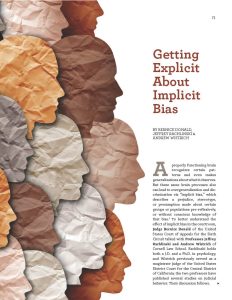 Getting Explicit About Implicit Bias
Bernice Donald, Jeffrey Rachlinski & Andrew J. Wistrich; from Vol. 104 No. 3 (2020–21)
Judges, like everyone else, harbor unconscious biases. But research shows that awareness and deliberate strategies can reduce their influence in the courtroom. In “Getting Explicit About Implicit Bias,” Bernice Donald, then a judge of the U.S. Court of Appeals for the Sixth Circuit, interviews two experts on the subject — Jeffrey Rachlinski, Cornell Law professor and a scholar at the intersection of law and social science, and Andrew Wistrich, former magistrate judge for the Central District of California. Their discussion highlights several practical steps that judges can take to counteract bias. It also demonstrates that equal justice demands vigilance, reflection, and ongoing effort from the bench.
For the full article, visit https://duke.is/examiningbias.
Excerpt
DONALD: What has your research shown about whether unconscious bias influences judges?
RACHLINSKI & WISTRICH: Our research suggests that the influence of unconscious bias on judges is subtle. We know that judges harbor many of the same implicit associations as most adults. For example, in our study using the implicit association test, we found that 80% of white judges more strongly associated Black faces with negative words, and white faces with positive words. Black judges expressed a more complex pattern, with some judges showing the same white-good/Black-bad association as white judges, but an equal number showing the opposite preference. . . .
What is more important for judges, however, is whether this bias affects their decision-making. Judges take an oath to be impartial and follow a code of ethics that demands that race does not play a role in their decisions. Commitments like these could motivate judges to avoid relying on implicit biases. In fact, we have some evidence that judges sometimes can avoid relying on their implicit associations when making judgments. . . .
DONALD: What can judges do to avoid implicit bias?
RACHLINSKI & WISTRICH: To begin with, we need to make sure that our expectations are realistic. Implicit bias is the product of deep acculturation. It accumulates over the course of a lifetime, beginning as early as age three. It cannot be fixed by an afternoon of [implicit bias] training.
Focusing on their own behavior, judges can take two categories of steps. The first is to reduce the role of stereotypes and other shortcuts in their decision-making. Reliance on intuition and “going with your gut” can be useful, but only if the technique matches the task. In general, the nature of judging dictates that judges are better off proceeding deliberatively, keeping the facts and the law — rather than impressions and feelings — in the driver’s seat whenever possible. Such measures include:
Avoid hurried rulings. Judges who are forced to rule quickly or feel rushed are more prone to make mistakes or to rely upon potentially misleading shortcuts and stereotypes, or upon the suggestions of others.
Take breaks, rest, and eat. Hunger and fatigue can produce reliance on intuitive judgment that is more easily influenced by implicit bias.
Use checklists and objective criteria. These tools promote structured thinking in which all cognitive and legal bases are considered. . . .
 The Collapse of Judicial Independence in Poland: A Cautionary Tale
Allyson Duncan & John Macy; from Vol. 104 No. 3 (2020–21)
In their article “The Collapse of Judicial Independence in Poland: A Cautionary Tale,” Allyson Duncan, a retired judge of the U.S. Court of Appeals for the Fourth Circuit, and John Macy, who was then a second-year student at Duke Law School, warn of a multifront assault on the rule of law in Poland. At the time the article was published, those warnings felt distant to many U.S. readers. Now — as a new government in Poland undertakes the slow, difficult work of restoring judicial independence — that reality is harder to ignore. Although the United States has not adopted Poland’s harshest anti-judicial measures, political actors have increasingly worked to discredit and delegitimize the judiciary. Here, Duncan and Macy highlight the importance of safeguarding the rule of law in the United States as well.
For the full article, visit https://duke.is/poland.
Excerpt
Through its reforms, the [Polish] Law and Justice party has demonstrated a profound disrespect for judicial independence and the separation of powers. Moreover, it . . . has waged an ideological public-relations battle against the judiciary in addition to its legislative assault. . . .
At its core, [Law and Justice party] rhetoric seeks to classify the judiciary as an impediment to democratic rule by the people, rather than a constitutionally mandated check on legislative and executive overreach. Of course, the end goal of the rhetoric is to justify the use of executive and legislative power unfettered by judicial review. The party has thus used social media and advertising to discredit judges and undermine public confidence in the judiciary. In 2017, the party launched an ad campaign that described instances of judges drunk driving, shoplifting, and starting bar fights. In 2019, Polish journalists exposed an online “trolling” campaign being organized within Poland’s Ministry of Justice. . . .
The objective of the rhetoric is relatively clear: The [Law and Justice] party seeks to justify its consolidation of power by sowing public distrust of the judicial branch. The strategy is a tried-and-true autocratic formula: a democratically elected body attacks constitutional institutions under the guise of a democratic mandate. . . .
It is understandably difficult to compare the situation in Poland to the United States. The United States has relatively strong judicial institutions, and its norms of judicial independence have developed over centuries of American history. By contrast, those norms are young in Poland. Poland’s constitution did not contain practical protections for judicial independence until 1989. The country’s current constitution, ratified in 1997, contains extensive safeguards for judicial independence, but the fact remains that those safeguards are relatively new.
Notwithstanding the differences, there are concrete lessons to be learned from Poland’s political crisis. Speaking broadly, the Law and Justice reforms demonstrate that a constitutional order that lacks respect for an independent judiciary is apt to betray its own constitution. Although our situation is not nearly as drastic, a growing tendency to politicize the judiciary is of legitimate concern in the United States. Furthermore, the [European Union’s] struggle with Poland highlights that a federal system of law depends upon the good faith cooperation of its members. As such, we are reminded that norms of judicial independence in the United States are crucial at both the federal and the state levels.
 Criticizing the Court: How Opinionated Should Opinions Be?
Orin Kerr & Michael C. Dorf; from Vol. 105 No. 3 (2021)
In “Criticizing the Court: How Opinionated Should Opinions Be?,” Orin Kerr, then a law professor at the University of California–Berkeley, and Michael C. Dorf, a Cornell law professor, engage in a spirited back-and-forth about the propriety of lower courts criticizing U.S. Supreme Court precedent. Their disagreements offer different views not just on judicial etiquette but also on issues related to the rule of law, newly relevant in a time of declining public trust in the judiciary. Should lower courts, as Kerr argues, limit themselves to formalities within legal opinions to maintain the legitimacy of the Court’s authority? Or, as Dorf rejoins, are lower court judges like workers on the factory floor, with a responsibility to stop the judicial machinery when precedents go awry?
For the full article, visit: https://duke.is/opinions.
Excerpt
KERR: I propose a simple rule for lower court judges to follow: If you want to criticize Supreme Court decisions, you should do it some place other than in a legal opinion. You can publish an op-ed, or you can write a law review article. But don’t publish your criticism of the Supreme Court as an opinion issued by your court, even just as a separate opinion only in your own name.
That’s the best approach, in my view, because judicial opinions are special documents. . . . [They] receive respect because they are legally operative documents issued by judges with the power to issue them. Their legitimacy rests on legal formalities that empower those opinions to be law instead of just opinion. . . .
As I see it, the formalities that give legal opinions their legitimacy imply a corollary that judges should follow: When you write a judicial opinion, you should limit yourself to what you have formal authority to decide. You should explain why you voted as you did in the case before you, as every legal opinion does. But judges shouldn’t also use legal opinions to pontificate about other views they have outside of the case and outside their authority. If the public respects judicial opinions for their formal power, maintaining that respect requires sticking to the limits of that formal power. . . .
DORF: As with [automobile factory floors], so with law. Most of the time, workers perform their assigned tasks. So, too, in most cases, lower court judges simply apply the law as given to them by the legislature, an administrative agency, or a higher court. Occasionally, however, they will spot a defect — a rule that misfires or that ought to but does not contain an exception. Many judges will, in such circumstances, find a way to read the rule in a way that serves justice. . . .
[W]e take for granted that where the law is sufficiently clear, lower court judges must follow it. There is no [safety cord] they can pull. Writing an opinion, concurrence, or dissent that criticizes the law a judge must follow is the next best thing. . . .
Sometimes a statute or opinion of a higher court will be based on a seemingly reasonable premise that proves false in practice. Trial court judges are especially well-positioned to discover such a misfiring in laws and higher court opinions that concern matters peculiarly within their expertise, like rules of evidence and procedure. Pointing out the mistake will speed its correction. . . .
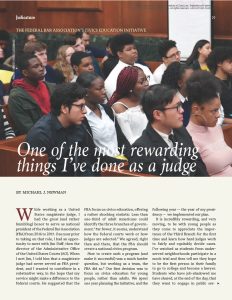 One of the Most Rewarding Things I’ve Done as a Judge
Michael J. Newman; from Vol. 106 No. 1 (2022)
Amid a crisis of public trust in the judiciary, several Judicature contributors joined forces in a thematic issue to highlight civics education as a lifeline for the Third Branch. In a piece titled “One of the Most Rewarding Things I’ve Done as a Judge,” Michael J. Newman, judge of the U.S. District Court for the Southern District of Ohio, recounts how he became “hooked” on civics outreach during his term as president of the Federal Bar Association. His reflections offer not only inspiration but also practical, hands-on ways to get involved, including one-on-one student meetings, naturalization ceremonies, and full-scale “court camps” for high schoolers.
For the full article, visit https://duke.is/rewarding.
Excerpt
It is incredibly rewarding, and very moving, to be with young people as they come to appreciate the importance of the Third Branch for the first time and learn how hard judges work to fairly and equitably decide cases. I’ve watched as students from underserved neighborhoods participate in a mock trial and then tell me they hope to be the first person in their family to go to college and become a lawyer. Students who have job-shadowed me have shared, at the end of the day, that they want to engage in public service — just like the lawyers and judges they’ve watched.
. . .
How did the civics initiative get started? At [the] suggestion [of Jim Duff, director of the Administrative Office (AO) of the U.S. Courts], I first called Rebecca Fanning, the AO’s national educational outreach manager. Rebecca and I met for two full days and she proceeded to show me every freely available internet civics resource she could find. She had also authored a substantial amount of civics materials herself, though they were located on the federal courts’ intranet and thus inaccessible to the public. I suggested, and she and Jim Duff graciously agreed, that the FBA [Federal Bar Association] could partner with the AO and host these civics materials for the public at fedbar.org/civics. . . .
Knowing how busy judges are, we set about organizing Rebecca’s materials by the amount of time a judge would have to spend with the students. We categorized the materials into four groups: “If you have 15–30 minutes,” “. . . 30–60 minutes,” “. . . 60–90 minutes,” and “. . . 2.5–3 hours.” This way, a judge with even 15 minutes to spare would hopefully be inclined to meet with students. I then made sure . . . that judges and court personnel knew about the civics initiative; knew that the FBA was working cooperatively with the AO; and knew that all the civics materials could be found on the FBA’s website. . . .
Federal judges throughout the country quickly took us up on our offer and started meeting with students in classrooms and courtrooms using Rebecca’s materials. The results were immediate and rather startling: By the FBA’s calculation, about 10,000 students met with a federal judge in school year 2016–2017, a number that increased by thousands in the following years.
 ‘The People’ Have Decided
Anthony Sanders; from Vol. 106 No. 2 (2022)
Federal power has long been viewed as the center of the constitutional order. However, emerging scholarship is paying new attention to state constitutions as dynamic and diverse alternative forms of governance. Few have done more to champion their relevance than Jeffrey S. Sutton, chief judge of the U.S. Court of Appeals for the Sixth Circuit. In this review of Sutton’s 2021 book, Who Decides? States as Laboratories of Constitutional Experimentation, Anthony Sanders, director of the Center for Judicial Engagement at the Institute for Justice, examines Sutton’s recent work and offers thoughtful commentary. This piece is essential reading for anyone navigating the evolving landscape of constitutional governance.
For the full article, visit https://duke.is/thepeoplehavedecided.
Excerpt
The book presents the full landscape of what state constitutions do on just about every relevant subject in addition to the sexy one (rights). It is mostly a primer, of sorts, on subjects such as judicial review, the structure of state executive branches, state administrative law, state legislatures, and local government. And rather than providing just a boring synopsis, he gives us stories and history, plus a comparison to how things work at the federal level.
Notice I said mostly a primer. A book within a book is also interwoven into the judicial review chapters. There the judge lays out his own views on judicial review — and not just in state courts but in federal ones as well. And it takes him back into some of that sexy territory. . . .
Much of today’s administrative law discourse concerns when courts should defer to agencies in interpreting statutes, usually in the context of Chevron deference. To hear some defenses of that deference, you would think it’s written into the Constitution itself. But, in the states, it’s much less common than you would think. State courts are all over the place in terms of how and when they defer to agency interpretations of the law, and only a few of them follow Chevron. Ten have outright rejected it.
Given that state courts (unfortunately in both my and Judge Sutton’s view) often follow the federal courts when it comes to rights jurisprudence, why do they not follow federal courts on these administrative subjects? Judge Sutton floats a few possibilities but doesn’t offer a complete answer (and neither do I). It seems that the fact that judges are often elected may take away some of the federal rhetoric behind the importance of delegation and deference. It could also be that since state executive power is already divided up — and thus limited — adding a nondelegation doctrine doesn’t seem as drastic. Whatever the reason, the experience of the states demonstrates that there are many tempests in teapots when it comes to fears of the U.S. Supreme Court taking a closer look at the machinations of federal agencies.
Space doesn’t permit much exploration of the book’s other areas, but I invite the reader to investigate Judge Sutton’s surveys on state legislative powers, redistricting, local government, and constitutional amendment. The redistricting issue has, of course, been in the news in recent years with courts such as Pennsylvania’s recognizing partisan gerrymandering claims as justiciable while the U.S. Supreme Court has not. One point of particular interest to me is the seeming death of the constitutional convention. States now appear content to serially amend their constitutions — which most can do relatively easily — and not gather citizens together to rethink the whole thing. They regularly did the latter throughout American history but haven’t done so in any state in almost 30 years. Judge Sutton guesses that fear of modern interest-group politics is the reason for this change, and he’s probably right.
 John Marshall’s Judicial Robe: Witness to Constitutional History
Kevin C. Walsh; from Vol. 107 No. 1 (2023)
U.S. Supreme Court Justice John Marshall’s antique, sweat-stained robes may not be much to look at now. As Kevin C. Walsh, professor at The Catholic University Columbus School of Law, explains, though, these robes have become a totem for many of the thousands of U.S. judges who wear them today, from the lowest trial courts to the highest bench. In “John Marshall’s Judicial Robe: Witness to Constitutional History,” Walsh debunks the myth that Marshall was the first to adopt the all-black robe, but he preserves the garment’s enduring role — including in some judges’ “pre-game rituals” — as a symbol of impartiality, uniformity, and the solemn work of judging.
For the full article, visit https://duke.is/marshallsrobe.
Excerpt
Under the expert care of a leading specialist who has overseen preservation of other priceless textiles, including the original Kermit the Frog puppet, Marshall’s black judicial robe has been restored and stabilized. The robe is now safely ensconced in a state-of-the-art, climate-controlled display-and-storage unit. . . .
Along the preservation-campaign trail, many judges shared how significant the robe was to them. Accompanying Marshall’s robe at the [museum] exhibit is a video compilation of testimonials by sitting judges — state and federal, trial and appellate — describing the significance of their own judicial robes and Marshall’s, as well as the tradition and symbolism of American judges wearing the judicial robe. These testimonies speak powerfully to the ongoing importance of passing on this tradition and supporting what it symbolizes. While some haziness remains about the history (not just of Marshall’s robe but also of judicial robes more generally), there is general agreement about what the black judicial robe stands for: It is solemn and dignified, a symbol of impartiality and uniformity.
The judicial robe has not been without its critics. One set of criticisms focuses on the robe’s perceived effects on its wearers. Critics contend that the robe makes judges haughty, better than the rest of us, above it all. There may be some truth to this for a small number of judges, but the opposite is true for most.
Judges say they like wearing the robe because they recognize it calls on them to be better, fairer, more polite, more patient, more discerning, both slower and quicker to judgment in the right degree, and so on. It is not so much that wearing the robe makes a judge a better person than that it activates their potential to be better. And for many judicial functions, it is a virtue rather than a vice to be “above it all.” In a typical adversarial dispute, the judge administers a form of commutative justice. The judge ensures that each receives his or her due vis-à-vis the other party. The judge’s job is not to pick winners and losers but to impartially administer a system of justice under law. In this sense, the black judicial robe is as appropriate for judges as black-and-white stripes are for referees in sport contests. In a well-working justice system, the identity of the judge should not be material to the quality of justice administered in any given courtroom. . . .
 Judge Anne E. Thompson: A Mentor and Guide, On and Off the Bench
Thomas M. Hardiman; from Vol. 108 No. 2 (2024)
Anne E. Thompson broke barriers as the first woman to serve on the U.S. District Court for the District of New Jersey and as the state’s first African American judge. And her legacy endures. Thompson helped shape the next generation of judges, including as a generous mentor to several judges featured in Judicature. In “A Mentor and Guide, On and Off the Bench,” Thomas M. Hardiman, judge of the U.S. Court of Appeals for the Third Circuit, reflects on Thompson’s influence and shares her enduring “pearls of wisdom” on everything from jury-utilization techniques to work-life balance. In celebrating Thompson’s career, Hardiman shares a vision of what “good judging” looks like.
For the full article, visit https://duke.is/annethompson.
Excerpt
Four years after becoming Mercer County prosecutor, Judge Thompson received her commission as a federal district judge, becoming the first woman to serve on the U.S. District Court for the District of New Jersey. She was also the first African American judge to serve in New Jersey and the sixth African American woman appointed to the federal bench nationwide. Judge Thompson was a trailblazer. But because of her remarkable humility, we didn’t learn any of those things while she served as our mentor. . . .
Judge Thompson considered teaching her law clerks and young lawyers an essential part of the job. For many years, she organized a weekly summer lecture series about litigation techniques and different career paths in the law for all the law clerks and summer interns in the Trenton courthouse. I am told that one of the highlights of the summer was a tour of the prison in Trenton and meeting with prisoners who served as paralegals to help fellow inmates file appeals and other pro se cases. She also took her law clerks on field trips to investitures, law school lectures, the New Jersey State Museum, and bar association meetings.
Judge Thompson continued to learn new strategies for presiding over trials and became known for her jury-utilization techniques. She was one of the first judges to allow jurors to take notes and ask the attorneys questions during trial. She learned technology skills at Federal Judicial Center workshops and taught jury-utilization techniques to other judges. So it was fitting that her law clerks would propose naming the jury assembly room in the Trenton courthouse after their beloved judge. . . .
It would be inaccurate to say that Judge Thompson’s most important worldly contribution is her jurisprudence. During baby judges’ school, she imparted another critical lesson: Judges are people, too. The work of a conscientious and devoted judge tends to be stressful, sometimes all consuming. But Judge Thompson emphasized that there was plenty of room for family life and hobbies. She spoke about her husband and children and her lifelong love for the theater. She encouraged us to keep first things first and to participate fully in life outside the law. . . .