

100 Years of the Federal Arbitration Act
by Paul Bland, John H. Chun, Linda A. Klein and Pamela K. Bookman
Vol. 109 No. 2 (2025) | Communicating to the People | Download PDF Version of Article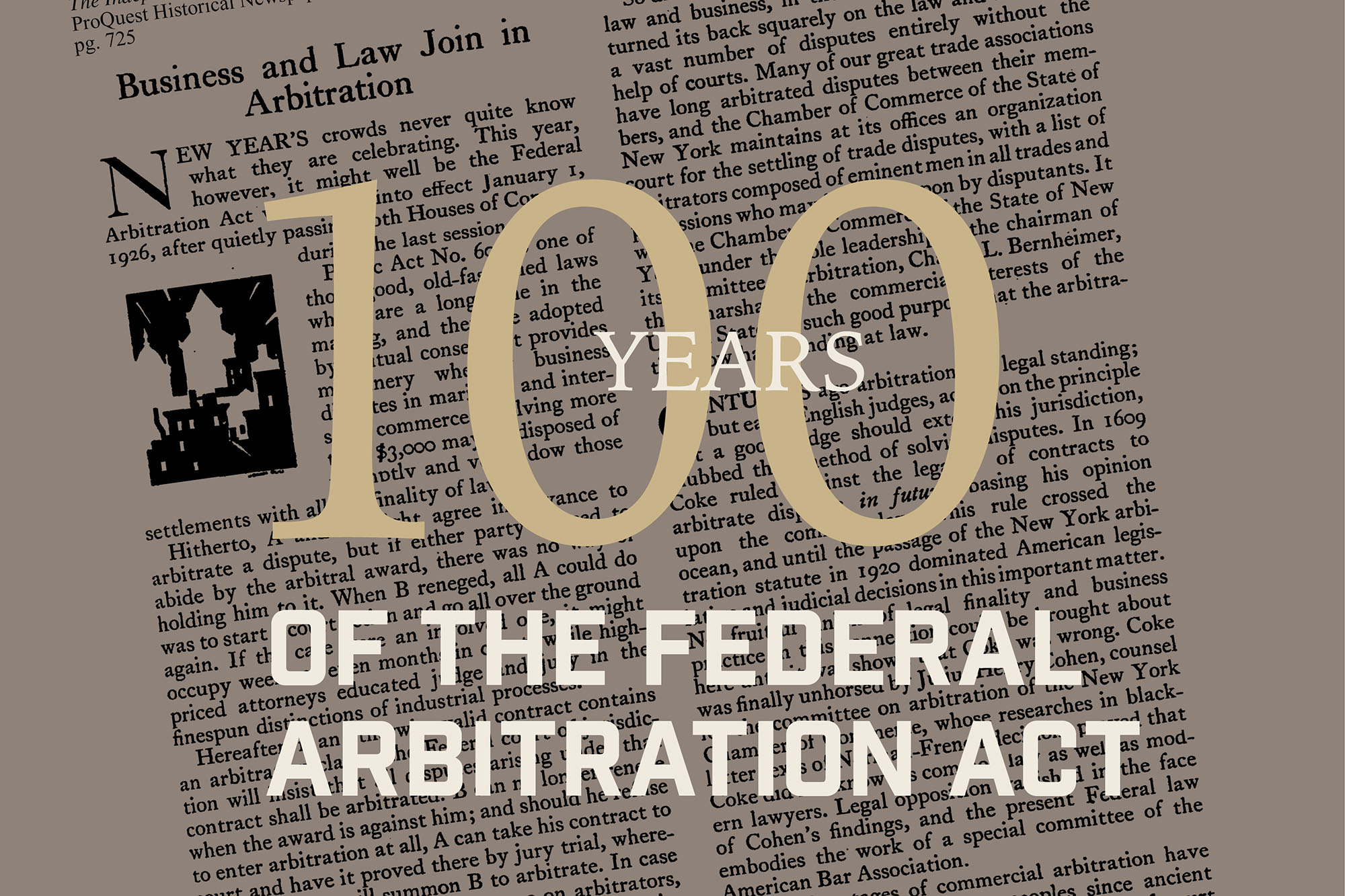
Passed in 1925 with scarcely a word of dissent in Congress, the Federal Arbitration Act (FAA) was designed to encourage arbitration agreements as an alternative dispute mechanism, particularly in commercial contexts. The act was the fruit of years of lobbying by trade associations, their attorneys, and the New York City Bar Association, buoyed by the support of then-Secretary of Commerce Herbert Hoover.1 It ensured that arbitration agreements were “valid, irrevocable, and enforceable,”2 preventing a court from setting them aside if valid.
Contemporary media greeted the act’s passage with great fanfare. The Independent, a respected and influential weekly magazine in the early 20th century, reported a long-awaited truce between two warring professions: “So draws to a happy close a long struggle between law and business,” the magazine announced, “in the course of which business turned its back squarely on the law and arbitrated a vast number of disputes entirely without the help of courts.”3 The American Bar Association trumpeted, “No piece of commercial legislation, no enactment at the request of lawyers has been passed by Congress in a quarter of a century comparable in value to this.”4 The numbers support this hyperbole: Over the past century, arbitration has grown significantly, and in 2024, the American Arbitration Association reported more than 537,000 claims filed.
In honor of the FAA’s centennial, Judicature asked representatives from private practice, the judiciary, and academia to share their views on the evolution of the historic act and its impact on the development of business, legal practice, and our democracy.
Panelists included Paul Bland, co-chair of Berger Montague’s Appeals and Complex Briefing Department; Pamela Bookman, Associate Dean for Academic Affairs and Professor of Law at Fordham School of Law; John H. Chun, judge for the Western District of Washington, and Linda A. Klein, a senior managing shareholder at Baker Donelson and past president of the American Bar Association. Amelia Ashton Thorn, articles editor of Judicature, served as moderator. Their conversation, edited for clarity, follows.
THORN: In 20 words or fewer, what is the legacy of the Federal Arbitration Act (FAA)?
BOOKMAN: I think the legacy of the FAA is a strongly pro-arbitration policy, but then the question becomes: How pro? And how far can the FAA go before it exceeds its original mandate?
BLAND: Expanding far beyond what Congress intended, the FAA has swallowed half of the U.S. Code.
CHUN: It’s mixed. In some ways, it’s been quite successful. But that “success” has been met with significant concerns and criticism.
KLEIN: A system complementary to the judiciary that evolves and helps make dispute resolution more efficient and responsive. In just three words: access to justice.
THORN: Mandatory arbitration clauses get a lot of attention, and in 2019, the House passed an act to eliminate certain kinds of mandatory arbitration. Is this issue rightly at the center of many ongoing arbitration debates? How necessary is a change to the current state of mandatory arbitration, and how likely is that change to occur?
BLAND: Arbitration between two commercially sophisticated parties of roughly the same power can be beautiful. Yet when imposed by a much stronger party on a weaker one — an employer on an employee, a payday lender on a consumer, a nursing home on a patient — it has been widely abused. Arbitrators are more likely to be corporate defense lawyers who tend to be defense-oriented in their approach and thinking. The system is largely secretive. The decisions are almost completely unreviewable. It’s almost impossible to get an arbitrator’s decision overturned by a court, and that’s led to a lot of problems. So on those occasions where Congress actually cares about something, it has exempted that cause of action from the FAA.
In the middle of the Iraq war, thousands of soldiers were targeted by payday lenders. So Congress exempted military servicepeople with high-interest loans from the FAA through passage of the Military Lending Act. The 2008 financial crisis led Congress to pass the Dodd-Frank Act, which exempted mortgages from the FAA, as widespread mortgage fraud had crashed the stock market. Congress decided to do something when the #MeToo movement exploded, and there was widespread understanding about how often sexual assault and harassment were occurring. Congress passed the Ending Forced Arbitration of Sexual Assault and Sexual Harassment Act in 2021 to say that those causes of action would not be sent to arbitration.
However, Congress hasn’t acted for other types of employment claims. If an employer pays women less than men, it turns out that a number of Republican senators believe that their voters aren’t worried about that issue, so those cases have been left in arbitration.
A huge body of empirical data shows that employers are significantly more likely to win in employment cases that go to arbitration, and the average award verdict is about 20% to 25% of the average award that an employee would get in court. So the FAA really is working against employees. I think it makes sense for this issue to be central for Congress.
If given a general and accurate description of arbitration clauses, voters across the spectrum are strongly opposed to the use of arbitration in employment and consumer cases. What’s happened is that one set of people in the legislature knows that their media keep their voters from knowing what they’re doing. But if this issue gathered enough public attention, I think you would see a dramatic shift fairly quickly in the way Congress treats it.
KLEIN: I’m not here to defend the status quo. But I do favor, let’s call it a third path, because I don’t think Congress will make changes anytime soon and create any more exemptions. What we ought to do is reform and update statutes and regulations regarding predispute, mandatory arbitration. This could include federal legislation that might be able to pass, codifying some of the protocols and allowing certain disputes to opt out. If all providers of dispute-resolution services were required to adhere to established protocols — perhaps by statute — a lot of the concerns could be ameliorated.
BOOKMAN: I also don’t think change is super likely anytime soon. Looking historically at the language of the FAA, there are arguments that certain topics were not intended to be included that the U.S. Supreme Court has since interpreted as included. So that ship has sort of sailed. But the concept that certain kinds of consumer unemployment contracts are meant to be excluded from arbitration is something you see abroad. The EU, for example, doesn’t accept arbitration clauses in several areas where the United States wholeheartedly allows them.
The reasons for that are the imbalance of power in terms of contracting in the first place — and then ultimately in terms of any arbitration that comes of it. The concerns stem not only from the history of and challenges to the status quo, but also from looking internationally to see best practices in other places. But frankly, I don’t think the current political climate entertains the comparative angle as a very persuasive one.
THORN: Common criticisms of arbitration are that it tends to favor large companies due to a repeat-player bias and that the current state of the law limits judicial review, which ultimately makes it difficult to appeal an arbitral decision. First, are these valid concerns? And second, if so, what can judges specifically do to protect against these problems?
BLAND: A Third Circuit case says that a “glaring” mistake is not grounds for overturning an arbitral decision. Judge Richard Posner has said that “wacky” contract rulings are not grounds for overturning an arbitral decision. The Supreme Court has said that “silly factfinding” is not grounds for overturning an arbitral decision. This is the narrowest scope of judicial review of anything with which I’m familiar in our legal system.
At the Supreme Court, a fairly significant shift in the last couple of years has not gotten widespread attention. You had a period of years where the Supreme Court was repeatedly expanding the act. And arbitration clauses were treated as super contracts or more enforceable than any other type of contract. But just as President Trump has a different set of concerns and views than previous Republican presidents, his judges and his Supreme Court justices do also.
What’s happened is that the Supreme Court has started to say — in cases like Morgan v. Sundance, Inc. — that these aren’t better or more enforceable than other contracts. This idea has not yet widely penetrated through to the lower courts. So you’re still seeing a lot of decisions in federal district courts and federal courts of appeals that still treat arbitration clauses as super contracts. What I really hope is that the lower courts will catch up to the Supreme Court’s more recent approach of treating the FAA like a statute that only says what its terms actually say and not invent a bunch of rules to force people into this. That will solve a lot of problems.
CHUN: If there are any such valid concerns, judges are limited, of course, in what they can do. We can speak and write about arbitration, we can share data from the courts — but we also need to comply with the rules of ethics, and, as you say, and as Paul just emphasized, the law limits judicial review of arbitral decisions.
Another context to examine is motions to compel arbitration. An interesting example of what a judge can do is a Ninth Circuit case called Heckman v. Live Nation Entertainment, Inc. from fall 2024. By way of background, in mandatory, single-file arbitration, plaintiffs have no recourse to class or collective procedures, and single-file arbitration has long been used by companies in contracts of adhesion.
In recent years, some plaintiffs’ lawyers have simply filed thousands or tens of thousands of single-file arbitration demands in parallel matters. Some call this relatively new phenomenon mass arbitration, and some on the defense side have gone on the counterattack. The Heckman case illustrates this. There, the Ninth Circuit affirmed a district judge’s refusal to compel arbitration between consumers and a large company. A significant concern for the panel appeared to be that the very new dispute resolution firm used by the defendant company and its attorneys had shown a “‘remarkable degree of coordination’ in devising a set of procedures to be followed when large numbers of similar consumer claims are brought in arbitration.” The Ninth Circuit went on to hold that the dispute resolution firm’s mass arbitration rules were both procedurally and substantively unconscionable. The case is an interesting example of what judges can do in addressing a relatively new phenomenon in arbitration law.
BOOKMAN: I’ll just add that what judges can do is limited to the kinds of cases before them and the precedents that bind them. This echoes some of what Judge Chun was just saying. That said, there are moments when litigants or lawyers create new techniques that judges can consider. It is a very difficult moment for a judge to step in and substitute their judgment on the merits of a particular case for that of the arbitrators. If the criticism is about favoring large companies due to repeat-player bias, that could be a gross misinterpretation of the law and its substance, but I think there’s something more institutional about that criticism than any given interpretation of a legal rule.
These moments are potentially more institutional when judges are confronted with a particular kind of procedure — a mass arbitration procedure, for example — or where state courts that regulate the bar and the practice of the legal profession can step in to determine what kinds of arbitration houses can be licensed to do certain things in the state. In Minnesota, the results of arbitrations by a particular arbitration house called the National Arbitration Forum were so lopsided — not in any one case but across the board — that the courts were presented with an opportunity to step in to say that the arbitration house was violating due process. So there are moments that judges confront that are both case-specific and process-wide. Sometimes the latter may present a better opportunity for judges to make an impact.
KLEIN: I’m a lawyer with small and large business clients who are negotiating contracts daily. The parties usually embrace arbitration, often with a prerequisite for negotiations, like mediation before arbitration. That’s a way to get their future disputes resolved more quickly and more cheaply. They prefer the system that’s flexible in controlling the cost of discovery. I can only imagine how much more the courts would be clogged if these disputes were added to the dockets. So what I’m trying to say is that limited judicial review is a feature — not a flaw — for my clients because it gets them a quicker resolution that favors all parties. I would argue that quicker resolution favors consumers as well.
Until arbitration protocols are adopted, I think we’re going to see more appeals of unfair practices, such as the unconscionability of the agreement or the award, procedural issues like denial of discovery, violations of public policy, and arbitrary excesses of power. But regarding repeat-player bias, evident partiality is already grounds for vacating an award. And of course, there are lawyer and arbitrator ethics. But I also want to tell you that there are a lot of places in the United States where there are only one or two judges in the court, and they go to the same church, and their kids play soccer together. And they probably went to law school together, and I know they have coffee together every morning at the courthouse. If you are a consumer from the other side of the tracks, particularly pro se, I think the result is going to be the same, and there’s going to be a repeat-player bias at the courthouse because they’re human beings. And I’ve certainly seen that happen.
BLAND: I have super strong feelings about this because I have a lot of history with it. This group, the National Arbitration Forum (NAF), was operating out of a strip mall in Minneapolis and advertising to mostly lenders that they were going to help lenders by protecting them from consumer lawsuits. They tried to monetize this business by urging lenders to let the NAF handle debt collection by lenders. A couple of large banks started doing tens of thousands of debt collections with them. A consumer with a $1,000 debt would often end up with the lender getting an award that was closer to something like $15,000.
I tried bringing cases to challenge these guys, but no court would let us take discovery — judges had a reaction along the lines of, “Well, the whole point of arbitration is not to have discovery.” I tried to get legal ethics experts to testify that some of their advertisements were unethical, but ethics professors essentially said that there were no ethical rules governing arbitrators’ conduct. When consumers reached out to me, I’d recommend that they contact their state attorney general.
Then, at some point, the Minnesota attorney general opened an investigation. It turned out that the law firm bringing tens of thousands of the debt collection cases before the NAF, and the National Arbitration Forum itself, had both received enormous investments by the same hedge fund manager. They were really bad actors. The Minnesota attorney general shut the operation down. But if it wasn’t for this sort of fortuitous act of an attorney general getting involved, those guys would still be governing half of America’s financial system from a strip mall. And to me, the NAF stands for the proposition that having a system that’s almost completely unreviewable really has some problems. I mean, American consumers were just sort of lucky to get them knocked out.
BOOKMAN: These are important topics because these issues are sources of real human misery for so many people. There were so many reforms to debt collection after 2008, but not all states have been trying to work on the small claims court and the other sorts of small-debt collection. One of the most numerous kinds of cases filed in U.S. courts are debt-collection cases — and my fear is that that will only go up in the years to come. How we deal with that is a huge issue.
I think state supreme court justices and those who regulate the bar, court system, and practice of arbitration within their states have opportunities to regulate both debt-collection litigation and possibly the availability of certain kinds of arbitration houses. I commend the work that Paul did in Minnesota on that front.
THORN: This discussion about consumers is a nice segue to a broader question about public confidence. We know that confidence in the courts has been declining; some say this may be linked to the declining number of jury trials, which has meant less public participation and perhaps decreased understanding of the system. How does the widespread use of arbitration fit into this picture? Does it further weaken confidence by steering cases away from the courts, or might it help rebuild it by offering another way for people to be heard?
KLEIN: Courts are desperately underfunded. Typically the whole third branch gets pennies at most, or in my state, fractions of pennies, of every tax dollar to fund the whole court system. And the docket keeps growing here, so the problem is exacerbated. It can take many years — sometimes as long as 10 years in my state — to get to trial, and that doesn’t help any litigant, least of all consumer plaintiffs. In my opinion, this greatly contributes to declining public confidence in the judiciary. Sensationalized media attention to high-profile cases also contributes to it.
I believe that confidence is primarily undermined by the time and cost of going to court. We get ready for trial multiple times before the case is reached, which is expensive, time-consuming, and messes up everybody’s schedule. And we can’t discount the effect that unpublished decisions have on litigants, as they often don’t understand why they lost. There’s also been a lot of discussion and publicity about the shadow docket.
Alternative dispute resolution administrators like the American Arbitration Association (AAA) offer consumers the ability to opt out of arbitration if small claims courts are available. Those are the courts specifically designed for ease of use by consumers, putting pro se claimants on more even ground. Bloomberg just published an article about victims of sexual assault and harassment — who have the opportunity, as Paul said earlier, to opt out of arbitration agreements — and how many of them are choosing arbitration for various reasons, including confidentiality. It’s their right to choose which way they want to go. The bottom line is that the more alternatives to court, the more access to justice, the more confidence in the courts.
CHUN: I haven’t heard anything about arbitration as a potential cause or potential solution with respect to public confidence. I think that the decreased confidence has more to do with political polarization and decisions by courts that make one side or the other very unhappy. And as Linda just mentioned, there’s a lot of media coverage of these decisions. I do think, however, that if we have a healthy system of arbitration, with a reputation for fairness and efficiency for all, that benefits everyone, including courts as there’s so much interplay between courts and arbitration. I agree they are complementary systems. And I’m guessing that this type of healthy balance is what the drafters of the FAA envisioned.
BOOKMAN: I don’t think that arbitration causes the lack of confidence either. I agree that it’s those other sorts of political issues. Regarding arbitration in sexual assault or harassment cases, I heard anecdotally that the best indicator of whether a woman chooses arbitration is how common her name is. You don’t want this court case to be the first thing that comes up when somebody searches your name. If your name is Jane Smith, then it’s less of an issue to go to court because you don’t have that same fear of it being the flag that follows you for the rest of your life publicly. So it’s a twist on the confidentiality issue.
So many things are driving the lack of confidence in our courts, from the highly polarized politics and the decisions that the judge mentioned, but also what we were talking about before on the debt-collection side — for example, the experience that especially pro se litigants have with the lowest levels of our state court system. If that’s a very frustrating experience or one that keeps you in the dark — even though the vast majority of those cases don’t involve lawyers at all or involve cases where the parties can’t afford lawyers — those experiences can challenge confidence in court systems.
THORN: We’ve spoken about some of the traditionally cited positives to federal arbitration, including that it reduces court backlogs, promotes a uniform and efficient approach, benefits from arbitrator expertise, and offers confidentiality and finality. Are some of these benefits more persuasive than others?
BLAND: The increase of cases into the courts is the most persuasive argument in favor of the act but as a plaintiffs’ lawyer, I think it would be really nice for certain types of cases to be able to get into court.
If we banned predispute arbitration of employment cases, would we see tens of thousands of additional cases in the federal district courts, and would that be manageable? This definitely has been on the Court’s mind. In 2001, in Circuit City v. Adams, Adams, who worked at Circuit City, brought suit, and Circuit City tried to force an arbitration. The legislative history of the FAA made absolutely clear that it was not intended to cover employment cases. The Supreme Court, by 5-4, said the language of the statute was supposedly so clear that they weren’t going to look at the legislative history. Justices John Paul Stevens and David Souter wrote strongly worded dissents. But Justice Anthony Kennedy, writing for the majority, said we needed to have arbitration here because otherwise it was going to lead to a flood of cases in the courts.
I can’t tell you how dispiriting it was to civil rights lawyers to be told by the Supreme Court that their cases were an unnecessary load on the federal courts. I do think it’s true that getting these cases out of court has reduced the backlog, but those cases matter, and I think it would be important for people to be able to have a jury hear civil rights cases. I do agree that arbitration is typically faster and that it’s a more streamlined system in many cases. That can bring advantages — but disadvantages, too. Often, there’s little discovery in arbitration, and that can disadvantage plaintiffs in certain types of cases. I’m at a firm that does a lot of antitrust cases, and having an antitrust case proceed all the way through to a hearing with very limited discovery can be a really difficult situation.
KLEIN: I have a lot of thoughts flooding my head right now. Yes, arbitration offers finality and other efficiencies, which my clients like and which I think will help consumers because they can get there faster and are more likely to win — although, as Paul rightly points out, with a smaller verdict, if you want to call it a verdict. The relaxed rules of procedure and evidence are certainly much more accommodating to nonlawyers. And there’s uniformity of rules across the country. I know that every time I litigate in a state court outside of my own state, the rules seem to be different. And then there is the number of courts. If you’re a consumer, how do you know which court to go to?
In my county, we have eight different courts, so that’s another big problem for consumers. For employment claims, in order to get a lawyer to consider taking a case on contingency, you’ve got to show at least $40,000 in potential damages, according to a recent study comparing AAA employment arbitration to employment litigation.5 I would argue that your case has to be worth a lot more than that to get a lawyer to take it on a contingency fee. A study shows that at least 38% of employee wins involve damages of less than $40,000.6 My friends on both sides of the employment bar tell me that in federal court, you get summary judgment in a lot of these employment cases. I looked up the statistics, and it’s like 1 to 4% of employees nationwide make it to a verdict in federal court.7 That same study also shows that 19% of AAA employment cases went before an arbitrator for decision, versus 1% of court cases that get a verdict by a judge.8
When I was a young lawyer defending doctors and lawyers sued for malpractice, the plaintiffs just wanted someone to hear their case. And more cases get to arbitration in employment and consumer cases — and they get there quicker than in federal court. I understand it’s about half the time for employment (16.6 months versus 31.6 months)9 and a third of the time in consumer cases (8.5 months versus 31.6 months), per AAA 2024 statistics.10 Without the availability of arbitration and alternative dispute resolution, it’s going to be even slower.
And courts are replicating arbitration by creating specialized courts, which are a response to public demand. They started in the criminal justice system, with drug treatment courts and veterans courts. But the business court is something that the business community has been pushing on the court system, and specialized arbitrators are really where I think a lot of this originates. Consumer cases have specialized arbitrators, as judges in small claims court are.
Finally, as for confidentiality, that is a choice and many parties choose confidentiality, but there’s nothing in the arbitration rules — at least the ones from the administrators I work with — that prohibits the parties from discussing their cases. Obviously, the arbitrator, just like the judge, has to keep everything confidential. As for employment cases, there’s something in the act — and maybe you can help me with this — where it says it won’t apply to contracts of employment of seamen, railroad employees, or workers engaged in foreign interstate commerce. Well, if they didn’t want it to apply to employment, they could have put a period at the end of employment, right?
BLAND: That’s the statutory argument that the FAA permitted arbitration of employment claims. But I don’t think that’s what that the Congress meant by that phrase. I think the legislative history was saying that, in 1925, the idea of what Congress could do to regulate the economy had not been particularly well developed. So the language you just identified was essentially just making a nonexhaustive list of kinds of employment involving interstate commerce that Congress was definitely allowed to regulate, and saying “the act doesn’t cover these.” They didn’t think they needed to say that it didn’t cover the other types of employment as well, which wasn’t contemplated then.
So I really recommend to people the briefs in the Circuit City v. Adams case because there’s a lot of legislative history there. We have a joke in my old office that a new lawyer would join and at some point would ask, “Where can we find the legislative history of the Federal Arbitration Act?” And the answer wasn’t “in this file cabinet,” but instead was “in dissents.” I honestly believe that the expressions of intent in the hearings and congressional debates were very clear that the Congress did not mean for the act to apply to employment. On at least one occasion, a union representative had shown up at one of the congressional hearings and said, “This is a terrible idea. Don’t do this to us.” And the legislative history shows that the Congress was responsive to this. But I agree that the language is not a model of drafting. And I’m not suggesting any court’s going to go back to where the fight was in 2001 in Circuit City v. Adams, but I do think that the subjective legislative intent of the 1925 Congress was not to cover employment. And there’s a lot of history about this.
KLEIN: Changing the subject slightly about the strength of arbitrating, the field has evolved with responsible and reputable arbitration providers — the International Institute for Conflict Prevention & Resolution (CPR), AAA, and Judicial Arbitration & Mediation Services (JAMS) — and I think they’ve increased access to justice, and they provide oversight to keep things fair. The AAA’s consumer due process protocols were developed by a big group of people representing everyone involved. They have the key elements in there: the right to opt out to small claims court as well as the right to representation, convenient location, clear notice, reasonable costs — and we could go on. But that’s where I think we have our best chance of reform and getting rid of the charlatans and providers that are not being fair. There are also employment due process protocols. I’m sure you know them and have reviewed them. And whether you think they’re enough or not, I think that’s our best shot at improvement if we can codify some of these protocols so we can narrow the area that administrators of arbitrations can move on to.
BOOKMAN: The premise of the question about the court backlog has a lot of embedded policy questions about what the work of courts should be about, how to keep frivolous cases out, how to encourage settlement and mediation, how to encourage other kinds of outside-of-court or outside-of-formal-dispute-resolution mechanisms, which kinds of cases should be in federal courts, and which are better adjudicated elsewhere. These are deep, complicated questions, and they go at some level to the heart of what it means to consent, which is the heart of arbitration in the first place. And I think the issue with the mandatory arbitration clauses in employment and consumer contracts is, at some level, the fundamental question about whether parties have actually consented to some of those arbitration clauses.
Those questions have been effectively answered by current doctrine. These are not open questions. But to even start to think about backlog, as Paul says, resurrects this very old question that we’re actually no longer talking about. The more recent question is about the class actions and small consumer claims that have been preempted. The idea is that you can bring them in arbitration, but unlike some of the cases that Linda was mentioning — where the parties go to arbitration and actually get a day in court before an arbitrator — these cases just go away; they don’t get brought at all. And I think, from some perspectives, people are happy about that outcome if they thought the cases were frivolous and shouldn’t have been pursued in the first place. But the question of backlog brings all these fundamental questions about what the courts are for, what kinds of cases they should be hearing, and when and under what conditions the parties are truly opting for arbitration.
CHUN: I agree with Pam that these questions raise interesting and big policy questions. How do we feel about the public being deprived of courtroom trials involving significant commercial and consumer disputes? Does the finality aspect stunt the development of case law? On another note from the judge’s perspective, I wonder about the extent to which arbitration is affecting the skill development of lawyers who want to try cases before juries.
THORN: Implicit in these discussions are questions about what we value when it comes to courts. That’s also relevant when it comes to international arbitration, which is governed by the New York Convention — which is in turn enforced by Chapter 2 of the FAA. How successful is international arbitration under the FAA in the modern age, and how do we define “success”?
BOOKMAN: The New York Convention is in many respects the most successful international treaty of all time. It has made arbitration and international arbitration a highly reputable dispute-resolution mechanism for parties that need a neutral place to litigate across borders, where maybe the court system of neither party is attractive to the other. It addresses many of the demands of the international business community. One problem that has surfaced is that there’s so much international arbitration in some areas that it has quelled the development of certain case law.
Some elements of New York contract law are litigated over and over again in arbitration, so you never get that court judgment clarification because the cases keep going to arbitration. I’ve written about the rise of international commercial courts as a response to that question, but there are quirks and nuances to how international arbitration and the FAA interact. But, in general, international commercial arbitration is the model case where arbitration is the most needed and desirable.
THORN: Where are we headed in the next 100 years under the FAA?
CHUN: I have no predictions. Amelia, you mentioned the 2019 Act in Congress. That was the Forced Arbitration Injustice Repeal Act or the FAIR Act — and that died in committee in both the House and the Senate in 2023. That was the last go-around. I think it’ll be interesting to see if it or something like it ever gains traction again. By contrast, as Paul referenced, the Ending Forced Arbitration of Sexual Assault and Sexual Harassment Act did get signed into law in 2021. I think it’ll be interesting to see if and how Congress addresses the continuing concerns regarding arbitration.
BLAND: I would say that, barring some enormous shift in the political landscape, it’s really hard to see Congress passing anything significant like the FAIR Act. At the same time, I think it’s really hard to predict whether there will or won’t be any big shifts. So in 2008, you had this financial crisis, and all of a sudden, the Dodd-Frank Act was passed in 2010. And I think that, in 2009, if you had asked a thousand lobbyists in Washington, D.C., what’s the one lobby that’s the most powerful in the city? I think the winner hands down would’ve been financial services — that banks were more powerful than oil or insurance companies. But then, suddenly, you had literally millions of people losing their homes and the stock market dropping about 50% at its nadir. And in that moment of crisis, this dramatic legislation passed that was probably the single biggest thing that Obama did in his first term, the Dodd-Frank Act.
And Dodd-Frank imposed sharp limits on arbitration in the mortgage setting. I’m not cheering for there to be a collapse of the economy or some social event that wrenches the country so much that Congress feels the push to do something. But the only way that I could imagine Congress getting motivated to do something on the scale of the FAIR Act is if something happened that galvanized public attention. A lot of things are happening in the country that were not widely predicted just a short time ago. What’s either the American political situation or the FAA going to be like in a hundred years? I have no idea.
KLEIN: The FAA was introduced in 1925 to eliminate hostility on the judiciary side toward arbitration and place arbitration agreements on equal ground with other contracts. It was adopted by Congress with no opposition. The law and the courts have evolved with society.
The drafters of the Constitution fought the Revolutionary War with muskets. Today, drones conduct war remotely. The courts wrestle with new concepts. First, it was the telephone, and then it was the internet, and now it’s AI and alternative dispute resolution, especially arbitration. The most recent example is the new rules on mass arbitration as a consequence of class-action waivers, which we really haven’t had time to talk about. But mass arbitration’s evolving rules are being promulgated. So adopting JAMS, AAA, and CPR protocols is going to help address consumer and employment disputes — and even disputes we haven’t dreamed of yet. The goal is to stop the bad actors. I’m hoping that Congress might act on these. So FAA arbitrations are going to continue to evolve, adapt, and improve — and I hope with some statutory assistance through codification of minimum protocol standards.
BOOKMAN: I can’t predict exactly when any statutory change will happen. It seems like so much of what has evolved over the past hundred years has been court-driven, and if I had to guess, it will continue in that vein. If and when there are changes, they will be court-driven as much as statutorily driven. But things will change. It’s also hard to believe that in 2125 we’ll still be dealing with the FAA of 1925. It seems like things must change because that’s what things do.
THORN: That uncertainty is certainly fair. Thank you all for your time.
PAUL BLAND is co-chair of the appeals and complex briefing department at Berger Montague. He was previously executive director at Public Justice. He has won cases in the U.S. Supreme Court, six
of the federal circuits, and 10 state high courts.
PAMELA BOOKMAN is the Associate Dean for Academic Affairs and professor at Fordham Law School. She is an expert in the fields of civil procedure, contracts, international litigation and arbitration, and conflict of laws.
JOHN H. CHUN serves as a judge on the U.S. District Court for the Western District of Washington. Previously, he served as a Washington state court trial and appellate judge and as an arbitrator for the American Arbitration Association.
LINDA A. KLEIN is senior managing shareholder at Baker Donelson and a past president of the American Bar Association. Her practice encompasses a wide range of business dispute prevention and resolution. She also serves as a neutral.
1 Katherine V. W. Stone, Arbitration — From Sacred Cow to Golden Calf: Three Phases in the History of the Federal Arbitration Act, 23 Pepp. Disp. Resol. L.J. 113 (2023) (citation omitted).
2 9 U.S.C. § 2 (1925).
3 Business and Law Join in Arbitration, The Indep. (1920-1928); Dec. 26, 1925, at 725.
4 American Bar Association Committee on Commerce, Trade and Commercial Law, The United States Arbitration Law and Its Application, 11 A.B.A.J. 153 (1925).
5 Harry C. Katz, et al., Comparative Analysis of Employment Arbitration and Employment Litigation, Nat’l Acad. of Arbitrators 15 (2023) (citing Mark Gough, Employment Lawyers and Mandatory Arbitration: Facilitating or Forestalling Access to Justice?, 22 Advances in Indus. and Lab. Rel. 105, 118 (2016)).
6 Id. at 11.
7 See id. at 7 (noting that roughly 3% of cases filed by employees reach a verdict in federal court).
8 Id.
9 American Arbitration Association, Employment Dispute Resolution Infographic (2024), https://go.adr.org/rs/294-SFS-516/images/2024_Employment_Dispute_Resolution_Infographic.pdf.
10 American Arbitration Association, Consumer Dispute Resolution Infographic (2024), https://go.adr.org/rs/294-SFS-516/images/2024_Consumer_Dispute_Resolution_Infographic.pdf.