

Former Pakistan Chief Justice Jillani Receives 2025 Bolch Prize
Vol. 109 No. 1 (2025) | Celebrating a Decade at Duke | Download PDF Version of Article
Photos by Les Todd /LKT Photography Inc
At an evening ceremony at Duke University’s Nasher Museum of Art on April 16, the Bolch Judicial Institute of Duke Law School honored Tassaduq Hussain Jillani, the 21st chief justice of Pakistan, as the recipient of the 2025 Bolch Prize for the Rule of Law.
The Bolch Prize is awarded annually to an individual or organization that has demonstrated extraordinary dedication to the rule of law and advancing rule-of-law principles around the world. Throughout his career, Jillani has stood for human rights, religious liberty, and the protection of judicial independence in Pakistan and worldwide. The Bolch Prize recognizes Jillani’s steadfast commitment to his country’s constitution and the rule of law as well as his groundbreaking judicial opinions, which have advanced gender equality, religious liberty, and judicial independence in South Asia and globally.
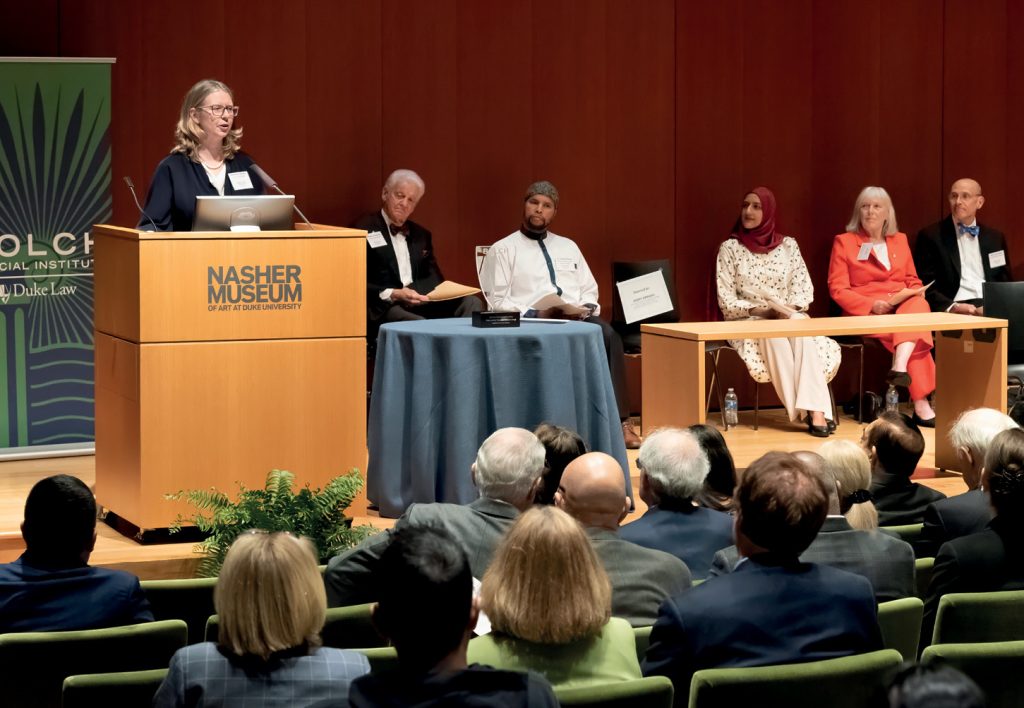
Kerry Abrams speaks at the Bolch Prize program.
In 2007, after Pakistan’s President Pervez Musharraf declared a state of emergency to subvert Supreme Court decisions relating to his reelection, Jillani was among a group of senior judges who refused to take a new oath of loyalty to Musharraf and were relieved of their judicial duties. This ignited the Lawyers’ Movement, in which lawyers throughout Pakistan protested the Musharraf regime’s assault on judicial independence. Jillani was reinstated in 2009 after Musharraf resigned.

Paul Grimm, Tassaduq Hussain Jillani, Susan Bass Bolch
The 2025 Bolch Prize Ceremony
The evening began with a greeting by Joshua Salaam, director and chaplain at Duke University’s Center for Muslim Life, who reflected on Jillani’s “life’s work of pursuing fairness, dignity, and justice for all.”
A welcome message from Kerry Abrams, the James B. Duke and Benjamin N. Duke Dean of Duke Law School and Distinguished Professor of Law, highlighted Jillani’s judicial opinions, which “advanced human rights, religious pluralism, gender equity, and modernization of education — even when those decisions defied political pressure, religious tradition, and public opinion.”
Taiyyaba A. Qureshi, founding president of the North Carolina Muslim Bar Association, called Jilliani “the true paradigm of a Muslim lawyer [and] an example to all of us on how to uphold justice and speak truth, especially when it’s hard, especially when it’s dangerous, and especially when an executive gathers together and flaunts its power, breaks down the rule of law, and demands that we accept it as the new normal.” She recalled being a young law student in North Carolina in 2007, “learning to be a lawyer while watching Justice Jillani and his colleagues on the court face a constitutional crisis.”
Featured speakers included Adèle Kent, a retired justice of the Court of Queen’s Bench of Alberta, Canada, and Bill Neukom, co-founder and chief executive officer of the World Justice Project — a nonprofit dedicated to promoting the rule of law around the world and for which Jillani is an honorary chair.
Paul W. Grimm, the David F. Levi Professor of the Practice of Law and director of the Bolch Judicial Institute, presented the Bolch Prize to Jillani, who, he said, “offers an important example to all of us and to so many judges and lawyers here and around the world who face growing challenges to judicial independence, attacks against judges, and the legal profession.” Jillani “has shown how judges, through fidelity to the law and dedication to fundamental human rights and liberties, can gain the trust of the people, and therefore the authority needed to act as a bulwark against the government abuse of power.”
Susan Bass Bolch, founder of the Bolch Judicial Institute, closed the ceremony with a message of “hope . . . that each of us will leave this evening inspired and determined to stand up for the rule of law, and to work together to protect the ideals that undergird our democracy, because without the rule of law, there can be no democracy.”
To learn more and watch the ceremony, visit https://duke.is/2025BolchPrize.
Excerpts from the 2025 Bolch Prize Ceremony

Taiyyaba Qureshi, Tassaduq Hussain Jillani
TASSADUQ HUSSAIN JILLANI
To me, this award symbolizes our shared values of democracy, of freedom, of the rule of law, of human dignity, of religious freedom and tolerance — values that are under severe threat today. . . . Historically, extremism and rule of law have been ill-wedded companions. . . . In modern democracies, it falls to the judiciary to play a more proactive role in enforcing the constitutional mandate in defending the people’s fundamental rights of equality, freedom, and justice for all.
[A]s some of you know, my nation has been, and is still, at war, against a far-reaching network of violence, extremism, and hatred. We are confronted at times with visible and invisible enemies. . . .
The anthem of the Supreme Court of Pakistan, which was authored by me, titled “And Justice for All,” [is] a constant reminder of the vision of the founder of the country that the ideals which reverberated the movement for the creation of Pakistan. Also, the anthem cautions the nation that, if those values which went to the making of the country were not honored, the nation would bear a high cost. The anthem is perched, along with its mosaic rendering, on the full wall beside the entrance gate of the Supreme Court. An abbreviated version of the anthem reads as follows, “Justice for all. The toil, the sweat, the tears, and the blood make the labor for the land begot. Long live the message, the lamp, and the rays that grow the temple, which holds the scales, pinning the dream, the hopes, and oath of justice for all.”
Ladies and gentlemen, it is important to remember that the judiciary alone may not be sufficient to create a society where rights are respected, where there is tolerance, and where believers of every faith are free to live by their respective beliefs. Each one of us has a role to play. In a democracy, there is one office you share with the rest, irrespective of your choice of career, your vocation, your religion, or sectarian or ethnic affiliation: This is the office of a citizen.
As a citizen, you are equal, whatever position you may hold — a teacher, a doctor, an engineer, a lawyer, an agriculturist, an industrialist, a father, a mother, a son, or a daughter. . . . Countries have witnessed persecution, tyranny, and intolerance only because the citizens did not play this role, leaving the demagogues, the fundamentalists, and the religious zealots to have their way.
Before I part, I may add that I have been deeply moved by the vision reflected in the Bolch Prize for the Rule of Law. It’s indeed in accord with the best elements of your nation’s model ethos. Democracies around the world would immensely benefit from such initiatives. Your law school is tasked with producing leaders who can promote the rule of law, be catalysts for social change. Through their thoughts and actions, they can influence the course of events both nationally and internationally. Your country today is at the pinnacle of its soft and hard power. It’s an awesome power, an awesome challenge, and an awesome opportunity, and, as such, it should espouse and promote only those causes and values it has lived by. This would inspire greater credibility and would strengthen your country’s claim of moral leadership.
You have a proud legacy of wrestling independence through blood and sweat, by holding certain truths to be self-evident, of risking civil war to secure human rights of judicial independency, laying down Marbury v. Madison, of authoring the Universal Declaration of Human Rights after the First World War, of leading the free world in the reconstruction of Europe, and then of self-accountability demonstrated in the rise and fall of McCarthyism. You have Dr. Martin Luther King and his inspirational dream. You have John F. Kennedy, his vision of the world. And finally, you can rightly take pride in having produced some of the greatest philanthropists known in human history.
For centuries, the Statue of Liberty, perched on the New York Harbor, has been a symbol of welcome, hope, openness, and freedom and liberty for people around the world. Why, with this glorious track record, [did I see] in The Economist magazine sometime back, the image of a tired and worried Lady Liberty sitting on a broken podium with a torch of liberty lying at her feet? Why did it talk of an unhappy America? Why did [journalist] Fareed Zakaria speak of the post-American world? Why is America facing a crisis having moral overtones in some of the issues in the realm of international politics? These are some of the questions — I will leave it to you to think and respond.
But you have a role to play, because, in the past, some of the illustrious members of your profession have provided inspiring and transformative leadership to the American people. Destiny beckons you to relive those moments and follow the shining stars of honor, dignity, and idealism, which adorn your heritage. And maybe, in moments of moral ecstasy, you may like to remind yourself of your founding father’s advice to the nation, carried in his farewell address as president. It has a strong message. It’s inspirational. It’s prophetic.
George Washington said, and I quote: “Observe good faith and justice towards all nations. Cultivate peace and harmony with all. Religion and morality, enjoin this conduct. And can it be that the good policy does not equally enjoin it? It’ll be worthy of a free, enlightened, and at no distant period, a great nation to give to mankind. The magnanimous and true example of a people always guided by exalted justice and benevolence.”
This is what your founding father said. With this message of hope, I take your leave. Thank you very much.

Adèle Kent
ADÈLE KENT
Let me start with the words of a wise woman from my country, singer and songwriter Joni Mitchell. She said, “You don’t know what you’ve got till it’s gone.” She was talking about taxis and relationships and parking lots, but it applies as much to judicial independence.
My thesis today is that there is no country in the world where judicial independence is not under attack in some form, and that judges alone have the responsibility to protect and foster a strong, independent judiciary. If we do not, it will be gone.
Let’s address a couple of points so we’re all on the same page. First, what is judicial independence? It’s two things. First, it’s the ability of individual judges to make decisions in discrete cases free from external interference or influence. And second, and sometimes in some countries this is a little controversial, is that judges are independent from outside influence and protect the country’s constitution and its fundamental values, just as we heard from Chief Justice Jillani earlier today. . . .
The second quick point is that judges have traditionally relied on lawyers to help, if not lead, the battle to protect judicial independence and defend judges from unwarranted attacks. Currently, I’m not sure we can assume that lawyers will have our back; lawyers have their own issues. The best way I can describe it without delving into the various issues that exist in different countries is that they’re going through a bit of an identity crisis. It’s happening in my country and elsewhere. Whatever is going on, we cannot presume that lawyers will be forceful advocates for an independent judiciary. We essentially are on our own.
So, the question is: What do we do? . . . The first thing we need to think about is that we, as judges, must conduct ourselves properly. Otherwise, we will fundamentally lose the public’s confidence. Judges must individually strive to uphold the highest ethical standards.
My second and third points are variations on the same theme. Judges need to speak out. Now, I appreciate, depending on the jurisdiction you’re in, this may be more or less controversial. . . . We need to be careful as judges, which can be challenging. We must not be perceived as interfering with the political process. On the other hand, we cannot be timid. When the task is to correct misinformation or the failure of other branches of government to support the judiciary, in my view, the job of speaking out rests with the chief justices or court presidents. They’re the ones who have the authority and the duty to say something. I think of my chief justice, both the chief of my court, the chief of other federal courts across Canada, the chief justice of Canada, the former chief justice of Pakistan, Justice Jillani.
Third, chief justices need to lead when issues of judicial independence become controversial. Puny judges, everyday judges have an obligation to speak to the public. . . . Write plainly so the public can understand our reasons. . . . Engage with the community, talking about the concepts of the rule of law and judicial independence in a clear and understandable manner. And to do that? The love of my life — education. We need to educate judges on how they can communicate forcefully, plainly, and carefully, remembering our role in a democracy, and also in an effective way.
So let me conclude with the words of another wise Canadian woman, a courageous woman, former Chief Justice Beverly McLaughlin, who spoke often and forcefully about the importance of an independent judiciary. She said: “Judicial independence, as its history attests, has not been won by fiat or accident. It has been won by the vigilance and courage of lawyers and judges over the century. We congratulate ourselves on our judicial independence, yet we would be foolish to take it for granted. Just as judicial independence has been won by long struggle. So it is by struggle that it will be carried forward into the future.” Thank you.

Bill Neukom
BILL NEUKOM
It’s an honor to be here to bear witness to the career of a good friend.
As the chief justice of the highest court of Pakistan, Justice Jillani displayed a quite remarkable and rare combination of intellect, discipline, and a willingness to take on the most contentious and important issues of the day from his bench. By means of his mastery of constitutional law in Pakistan and his powers of persuasion, he led his colleagues to clarify and reinforce notions like freedom of religion for minority folks. And that was probably the most famous decision in the annals of that court. That was their Brown v. Board of Education, if you will.
The court went on, again, under his leadership and prodding, to recognize gender equality, a concept not commonly accepted at the time, and the right of a woman to choose her spouse. The right to an education for all Pakistanis came from the Jillani Court — all of these constitutional renderings emerged within an evolving constitutional ecosystem in Pakistan. Trail-breaking stuff. . . .
The rule of law is a capacious concept. One definition says it’s made up of four essential elements. First, accountability of all private and public actors. There was accountability in apartheid South Africa and in the Third Reich. So the accountability has to come under a set of universally just laws that uphold human rights. Check that box for Justice Jillani.
The second element is due process — some form of contract and property rights, and a whole slew of those rights that fall under international human rights. The best place to look for that probably is the International Bill of Human Rights, which includes, of course, the Universal Declaration, Eleanor Roosevelt’s masterpiece.
The third element is open government. Justice Jillani’s court, I don’t think, did anything behind closed doors.
And finally, to get to today’s theme, and the brilliance of the charge from the Bolches, it has to involve some manner of accessible justice, and that justice has to be impartial and independent.
I pause to reflect on the genius of the charge to the Bolch Judicial Institute. It’s a judicial institute, but it is charged with advancing the rule of law. And we have an example of someone who has outperformed in each of these elements: accountability, just laws, open government, and accessible, impartial justice.
On a personal note, if I may, one of the striking features of this honoree is that you would think that an esteemed jurist, recognized throughout the world for his courage and his jurisprudential insights, might feel a bit privileged or entitled. This is not Justice Jillani. He has an enviable sense of humility about his work and his life. When we founded the World Justice Project in 2007, much inspired by his heroic deeds in Pakistan, we made a priority of a thing called the Global Forum. We hold it every other year, bring people together from all around the world, and the point is to learn together about the rule of law. What does it mean? Why is it important? What can we do about it?
And Justice Jillani, at considerable expense and imposition, has traveled long distances to meet with us at many of those. Sometimes, as a presenter — we want his wisdom — and sometimes, just in the audience. He’s perfectly content to be in a group learning and teaching.
On a lighter note: his anthem. I couldn’t help but think about Fred Astaire. Not many of you in this audience are old enough to know who Fred Astaire is, unless you watch Turner Classic Movies, but accept the proposition that Fred Astaire was perhaps the greatest dancer in the history of Hollywood. Some would say Gene What’s-His-Name, but I would say Fred Astaire. His partner was better because she did it backwards in high heels, of course, but for male dancers, he set the standard, a remarkably talented guy in dozens of movies. As a young actor, he went for a screen test, and the review was, “Cannot sing, cannot act. Dances a little.”
For Justice Jillani, a screen test would say, “He can advocate, he can adjudicate, and he could do a little songwriting.”
Justice Jillani, thank you.