

In Conversation With Sundaresh Menon, Chief Justice of the Supreme Court of Singapore
by Sundaresh Menon and David Collins
Judicature International (2026) | An online-only publication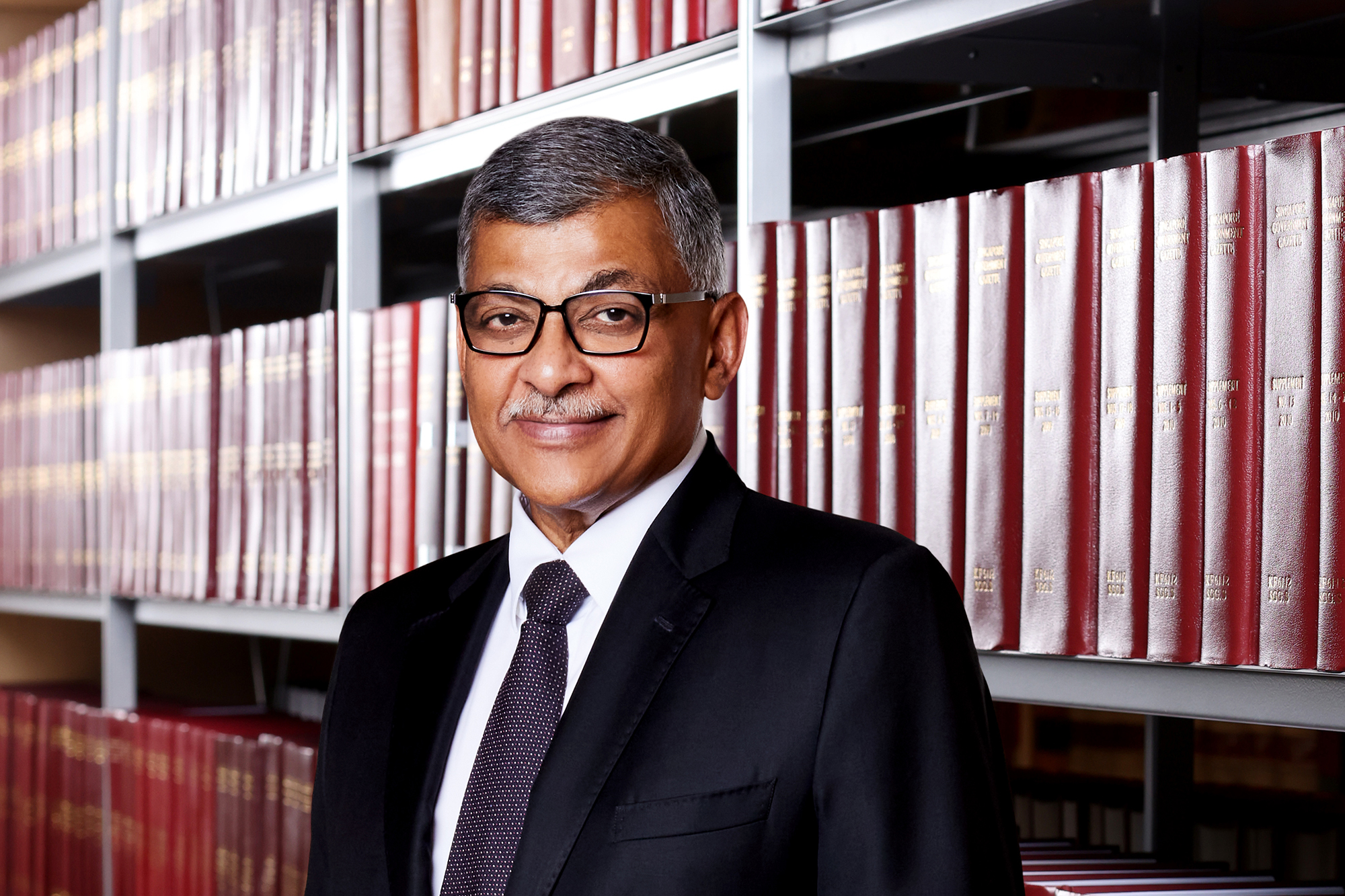
Singapore Chief Justice Sundaresh Menon discusses how courts can preserve public trust and judicial independence while adapting to new demands on the justice system.
Singapore’s judiciary has played a central role in shaping the country’s legal and institutional development since independence. The courts operate within a constitutional system rooted in the Westminster tradition but adapted to Singapore’s unique circumstances as a small, diverse, and highly globalized state. Under the leadership of Chief Justice SUNDARESH MENON, the judiciary has emphasized institutional integrity, innovation in court administration, and engagement with emerging global legal challenges.
In this interview for Judicature International, DAVID COLLINS, acting judge on the New Zealand Court of Appeal and chair of Judicature International’s editorial board, speaks with Menon about Singapore’s constitutional structure, the evolving challenges facing courts and the legal profession, and the role of the judiciary in maintaining public trust in the rule of law.
JUSTICE COLLINS: Thanks so much for joining us, Chief Justice Menon. Could you briefly explain how the balance of power among the branches of government in Singapore is designed and maintained?
CHIEF JUSTICE SUNDARESH MENON: Thank you, David. Singapore, as a former British colony, essentially follows the Westminster system of government, with three branches. One point of difference from the UK and several other jurisdictions is that we have a unicameral, single‑chamber parliament.
But it’s essentially the Westminster model: Parliament produces the executive because the party with the largest number of seats forms the government, and the person likely to command the confidence of the majority in Parliament is the head of the government. We also have one office that sits slightly outside the traditional Westminster model: an elected president. This constitutional development was introduced about 35 years ago. The office was conceived as a part of the separation of executive power.
The president is not an executive president; rather, he is what I describe as a custodial president. He has certain veto rights, and they’re quite important. Because of these powers, he is the only person elected nationwide, so the entire voting population chooses the president, whereas members of parliament are elected in constituencies.
Then we have the judicial branch, which you are extremely familiar with.
A second point of interest in Singapore, which differs slightly from the UK, is Article 4 of the Constitution, which makes the Constitution the supreme law of the land. There is therefore power to invalidate legislation that is inconsistent with the Constitution. We are not, in that sense, a parliamentary supremacy that cannot be controlled by the Constitution.
The second part of your question — how that balance is maintained — touches on constitutional culture.
In Singapore, I think the most significant starting point is how we came to be a nation; that casts its shadow over everything that has followed in terms of how the Constitution and the legal power of the state work and are maintained.
We recently celebrated the 60th anniversary of nationhood, but independence as a single state was never the original plan. It was always conceived that Singapore would find its way to independence from its colonial past in the context of being part of a larger whole, as part of a union with Malaysia.
We came out of colonialism in 1963 as part of a federation that included not only the states of West Malaya, what is now West Malaysia, but also Singapore, Sabah, and Sarawak.
That’s why Malaya came to be known as Malaysia, to include the three states that joined in 1963. After two years, we were out of the union and in some sense had independence thrust upon us. I think, in many respects, we could be seen as the first truly independent city-state.
I don’t think it was a given that we would survive in 1965 when we became independent. To illustrate why it was such a dramatic moment in our history, we had to enter into agreements with Malaysia to get our drinking water because we are such a small place that we didn’t even have enough fresh water to make sure our people could survive. Under the agreements, we pay for the water. We also treat it and sell some of it back to Malaysia.
These were the kinds of circumstances our founding government was faced with, and it explains the real spirit of pragmatism that drove their work.
Our first prime minister, Mr. Lee Kuan Yew, made a point that offers insight into how people were thinking about the Constitution. He talked about the Constitution having to achieve a fair spread of executive authority with checks and balances but, most importantly, to allow Singapore to carry on and survive with a working structure, without having to reinvent the framework that could secure good and orderly government. Governance was a key feature of the way we think about the rule of law.
When we speak about that spread of powers, we have the traditional separation of the three branches that I spoke of at the outset of these remarks.
In addition, we also have a couple of other layers. For instance, we have certain executive offices that are more hard-coded as separate from the executive. The best example is the office of the attorney-general.
It’s a full-time, executive appointment. The remit of the attorney-general is a very broad one. You are the public prosecutor, so you perform the duties of the director of public prosecutions. That’s roughly half your work. You are chief counsel to the government, so you advise on all matters affecting the state. You are the parliamentary draftsman,overseeing all matters pertaining to the drafting of legislation, and the chief legal adviser on international law, which means you also look after treaties and the legality of international action. The role is constitutionally insulated in that the attorney-general has a status, security of tenure, and constraints against removal similar to those that would apply to a judge. The attorney-general holds a very high rank, but it is not a political office.
Another example of how we have worked in these kinds of structures is the office of the president. Under the elected presidency, the president of Singapore has important custodial functions. One of his key powers is to withhold approval for the government to draw down on our reserves. Now, for a country with no natural resources, over the course of six decades, we’ve built economic reserves, and that’s part of our national economic heritage. It belongs to the whole of Singapore for Singapore’s purposes; it cannot be drawn on for expedient political purposes. The office of the elected president was created with the power to say no to the government of the day if it wanted to draw down those reserves. There are certain built-in gridlock provisions, but that’s a significant control.
A second key custodial power of the president pertains to key appointments in the public service. The president acts independently and can block the government if it seeks to put forward people whom the president, in his discretion, considers not to be suitable or appropriate. So, the idea, again, was to ensure a fair spread of powers, so that you don’t have an unmanageable concentration of power. At the same time, pragmatically, you want to be able to avoid a gridlock to enable the government to function well.
Then, in terms of checks and balances, the obvious check and balance is judicial review, which is provided for, and indeed strengthened by, Article 4 of the Constitution on constitutional supremacy.
Because of this emphasis on making the system work, I think the judicial philosophy toward review has been collaborative.
If we think that a power is not being exercised validly, legally, or within the bounds of legality, we call it out. But we also emphasize the importance of lane discipline: understanding our role, the other branches’ roles, and respecting and preserving the space within those lanes.
It’s useful to give you one example of how this actually worked, because it’s quite recent.
A challenge was brought in respect of Section 377A of the Penal Code, and this was a colonial-era provision that essentially criminalized certain types of sexual conduct, specifically homosexual conduct between men. The challenge was brought on various grounds, one of which was Article 12 of the Constitution, which is the equality provision. Now, when the case came before the appellate court, the court decided the matter on the basis that there was a substantive legitimate expectation created because the attorney-general had issued a statement saying he wouldn’t be prosecuting under this section.
We ruled based on the substantive legitimate expectation that the section could not be enforced, which meant that there was no risk of any constitutional rights of the affected parties being violated. But we then analyzed the constitutionality of the provision. While we didn’t strike it down, we made some observations that might have given a fair-minded reader the impression that there was some issue that needed to be considered.
When the judgment came out, the government announced it would consider the best way forward in relation to the provision, in light of our decision. It then held about four or five months of consultations with various groups that might be affected, including the LGBT community and religious groups in Singapore. Then, I think it was about six months after our judgment, the prime minister announced that the section would be repealed.
But significantly, when he announced that, he said he had been advised by the attorney-general and the minister for law that, on their reading of the judgment, there was a risk that the provision would be struck down by the court if it had to be resolved there.
I give that example because I think it shows how effective dialogue between the branches of government can contribute to collaborative governance. It allowed a potentially sensitive issue in the context of a multicultural, multireligious society like Singapore to be addressed, defused, and dealt with through a lengthy process of consultation that would never have been possible if the courts had felt that they should view it purely as a legal question and ignore the legitimate spaces that could be better filled by the other branches.
JUSTICE COLLINS: Tell us about the threats confronting judicial independence, both in Singapore and, from your perspective, globally. How do courts go about countering those threats?
CHIEF JUSTICE MENON: From the beginning, our founding government was acutely aware of the importance of the rule of law. Because of that, we’ve never before in our history had to deal with government either criticizing, attacking, or undermining the judiciary, or doing anything that would weaken the strength of the judiciary. In fact, last year, when we celebrated the 10th anniversary of the Singapore International Commercial Court, our former prime minister, Mr. Lee Hsien Loong, was the guest of honor, and he described the rule of law as a cornerstone of the Singapore model, permeating every aspect of governance. He said the consequence of this was that you need the legal and justice system to be staffed by strong judges who can interpret and enforce the law. They have to be at least as able, if not even more able, than the counsel who appear before them. They have to be incorruptible and willing to observe their oath to act without fear or favor.
That’s been an integral part of how the judiciary has been viewed in Singapore, and many things demonstrate that, including the very high public confidence levels that we continue to enjoy in Singapore.
I don’t think these are things you ever take for granted. The reality is that judiciaries in many parts of the world are vulnerable to threats, and they can broadly be categorized into a few groups.
The first are threats from the power elite, where the judiciary is sometimes seen as an inconvenient feature. When you don’t like their decisions, when you feel that they get in the way of your political agenda, the power elite can sometimes resort to measures to try to undermine the ability of the judiciary to discharge its functions. That’s a dangerous and unwelcome development.
One of the things that I think a judiciary absolutely needs is a general acceptance in society that its decisions are made honestly. You may not agree with a decision, but you need society to generally recognize or accept that the judiciary is acting honestly. I think that every time the power elite makes statements that undermine that confidence, it has grave consequences for the judiciary and our ability to discharge our work.
Some jurisdictions have gone further than that. They’ve gone to the extent of changing the way judges are appointed, for instance, changing their rules on tenure, or posting misinformation about justice systems, just to weaken the justice system.
I think a second aspect of how judiciaries are attacked comes from the fact that the public can sometimes also push back against decisions and react, and I think that tends to happen when attacks on the judiciary are normalized within the wider picture.
When you normalize attacks on the judiciary and the idea that judges aren’t acting honestly and independently, that can permeate the wider culture and society. Then people cease to accept us or operate on the premise that judges are trying to do their work honestly.
In thinking about how we respond to some of these challenges, one of the things we are very focused on in Singapore is ensuring that we protect and preserve public confidence and trust so that people generally will believe that what we’re doing is honest and to the best of our ability in accordance with what we see the law to be.
It also explains why we stay clear of politics and policy preferences. It’s one thing to speak about what is legal and illegal, what is permitted or not permitted under the Constitution, but the line can shade into a situation where you end up stepping into policy preferences. When you’re there and you’re not a political player, that becomes very corrosive, and we stay away from that.
I think the third thing is that we take the view that we play a very important stabilizing force in society by providing just that kind of neutral umpiring to hold the balance between factions and society.
In any society, conflict is inevitable. Our role is to manage those conflicts and resolve them in ways that promote and build peace within society.
JUSTICE COLLINS: What do you think are the biggest challenges facing judges and courts in Singapore today?
CHIEF JUSTICE MENON: The challenges we face are probably common to those of many jurisdictions, but let me touch on those uppermost in my mind. The first is complexity. In 2021, I gave the Goff Lecture in Hong Kong and spoke on the complexification of disputes. It’s a concept I’ve referred to quite a lot because I think that it is a real issue affecting our ability as a judiciary, as a justice system, to carry out our work.
We face complexification at three levels. We face complexification at the level of technical complexity, and we’re seeing it in how technology is being infused into every part of our lives. Judges have to be able to understand and adjudicate in many areas within a domain they may not be familiar with and to confront issues they have no experience with, and such complexity is increasing at a rapid rate.
It’s matched by ever-growing legal complexity. Look at the number of laws and the volume of laws in each society, the length of judgments, and the complexity of the arguments that are being presented. On top of that, with the ever-rising incidence of transnational relationships, you more frequently have to deal with conflicts of laws and multiple bodies of law, including foreign law.
Then the third factor is what I call evidential complexity, which is down, first, to the explosion of information. You no longer have cases that you largely can resolve with a couple of hundred documents. That would be considered a good-sized case. Today, you’re sometimes talking about a couple of hundred bundles. Added to that dimension is what I call the scientization of proof. Everything becomes a matter of getting an expert to speak about it.
Complexification has significant consequences for courts because, for one thing, there is a real risk of information overload. Then there’s an additional problem of finite adjudicative resources — we have a limited number of judges.
All of this has a huge impact on judicial well-being and your ability to carry out these very onerous tasks that society entrusts you with. This is a huge issue, and we’re dealing with it in a variety of ways. We’ve got protocols to encourage parties to simplify things. We have a significant judicial education program to emphasize what we call T-shaped learning:deep expertise in core areas combined with familiarity with adjacent fields such as statistics, psychiatry, or technology.
In some areas we are also exploring the use of artificial intelligence to assist with access to justice. For example, in the Small Claims Tribunals — where lawyers do not appear — we are working on systems that can help laypersons translate documents, summarize materials, and better understand their cases.
A further challenge concerns changing expectations among court users. All courts, including ours, increasingly see self‑represented litigants who may lack legal knowledge and may find court processes difficult to understand. If people begin to see the justice system as something only elites can navigate, that can be corrosive. For that reason, we established an Access to Justice Division dedicated to identifying barriers faced by laypersons and finding ways to address them.
The third challenge is the sustainability of the legal profession. To what extent do young lawyers see a future for themselves in the law? Five or six years ago, I decided to conduct an annual survey asking young lawyers how they felt about the profession and what they saw for themselves; the resulting picture was somewhat disturbing. A growing number of them do not see a future for themselves in practice.
It’s a function of various things. There’s a multitude of career options. They see a lot of challenges with Gen AI and how it’s going to put them out of jobs and training opportunities. There’s a ton of complexity in the work they’re being asked to do, along with very demanding clients, and many of them say, “I can get a better living doing a different job.” If we don’t have a sustainable profession, I think we are in trouble.
JUSTICE COLLINS: Thank you for that. I think judges all around the world would relate to exactly what you have said. Coming back to the rule of law: How would you describe the Singaporean model of the rule of law, and to what extent do you think it might be misunderstood internationally?
CHIEF JUSTICE MENON: Let me start with something that Mr. Lee Kuan Yew said, because I think it helps contextualize what I’m going to say, and it addresses your point about the possibility of misunderstanding. He used the analogy of architects, and he said, “Look, our architects go to Europe; they’re inspired by the Greek colonnades and the Roman structures and the beauty of St. Paul’s Cathedral. But then they come back to tropical Singapore, and they’ve got to figure out a way to make those ideas work in our very different climate and environment. It’s a tropical place with a lot of rain, and you’ve got to make it fit for our people.”
I think that philosophy applies equally to the rule of law and our model.
We draw from the same well — the English parliamentary Westminster system — but we’re a different society. We’re not England, Australia, or New Zealand. They are some of our best friends, and we have a lot in common with them, but we’re not the same. And because of that, we’ve got to deal with our issues in ways that are slightly different.
This has led to some observers thinking of Singapore as something of a city of contradictions. They think of us as innovative, but also as a paternalistic society.
They think of us as having low corruption, but then they also sometimes feel that we’re a bit of a police state, with an undue emphasis on law and order.
They think of us as being very cosmopolitan, but we’re also sometimes described as confused in terms of our ethics and outlook.
That might seem contradictory, and I think the real answer is that there’s a little bit of truth to many of those labels, but it’s in how we bring them together that gives us our identity.
Now, in the specific context of the rule of law in Singapore, we share with all of you the ideals of what the rule of law should mean, the values of the rule of law, the importance of an independent judiciary, and the need for maximum space for individual rights. We share all those values.
But we also place a very high premium on the practical outworking of the rule of law. We think the rule of law achieves its fullest value when it delivers good governance for our people, provides law and order and stability, and promotes development.
One of the most precious things that anyone coming to Singapore says is the feeling that you can walk out or go for a jog at 2 o’clock in the morning, whether you’re a man, woman, or child. That is not to say that you will never be harmed, but it would be highly unusual.
Now that’s our focus. We very much want to move the rule of law from the realm of theoretical values to values that are worked out in practice to deliver good outcomes.
I can give you a couple of examples of how this has shaped decisions and the way we’ve worked through the years. One example is that when we became independent, the spirit of the time was very much self-determination and, to some degree, anti-colonialism.
But look, we were an island state of 225 square miles with a couple of million people with no natural resources. And one of the things the government decided at that time was something that cut against the trend of the time. In essence, they took the view, “We’ve got to make Singapore a working magnet for foreign direct investment.” That means you’ve got to have zero corruption, well, as near to zero as you can have. You’ve got to have effective judicial institutions; you’ve got to have an effective ability to enforce contracts. And you have to invite foreign companies into your country to earn their trust, even though everybody else is saying this is a form of neocolonialism.
We did what we had to do, and today we’ve become one of the most sought-after destinations for foreign direct investment.
Another example that I like to point to is our emphasis on communitarian interests. We live in a society made up of many different races, religions, and groups. It’s easy for rifts and fractures to take hold in such a society. Our public housing system houses about 80% of the population. We have a policy requiring that the racial composition of each precinct reflects the national average. Some observers see this as a restriction on individual choice. But this policy is intended to prevent the formation of racial enclaves and to encourage daily interaction among communities, so that you start to see yourself as one rather than as many.
This is an example of how, because of our emphasis on governance and stability, we place a greater value on communitarian goods rather than invariably prioritizing individual interests.
JUSTICE COLLINS: What do you think are the biggest rule‑of‑law issues facing Singapore today, and what global trends influence those challenges?
CHIEF JUSTICE MENON: One issue I have already mentioned is the sustainability of the legal profession.
Another is declining trust in institutions. A few years ago, we invited researchers to speak to our judges, and they warned us that declining trust could become an existential challenge for institutions. Since then, we have seen growing evidence of distrust becoming widespread in many societies. While this trend has not taken root in Singapore, it is something we do not take for granted.
A further concern is the broader global environment. Our president once described the world as facing a “perfect long storm” — including geopolitical instability, climate change, misinformation, rising inequality, and I would add to that the explosive growth of generative artificial intelligence.
These challenges raise profound questions about the role of law. The law provides a platform for us to collaborate with one another, and legal frameworks will be essential if societies are to cooperate in addressing problems that do not respect national borders.
This is one reason we are marking the bicentennial of our courts this November with a global rule‑of‑law conference, where we hope to place some of these issues on the agenda.
JUSTICE COLLINS: How do judges in Singapore go about educating the public about their work?
CHIEF JUSTICE MENON: Public education is critical because you can’t expect high levels of confidence and preserve your legitimacy unless people understand what you’re doing. It’s only when they understand what you’re doing that they will see it as important to protect the conditions in which we can do our work well.
It used to be the case — I think you and I will still remember — that judges would let their judgments speak for themselves. To some degree that is still the case, but we have gone beyond that. In 2023, we introduced “Conversations with the Community,” a series of seven events covering seven distinct topics, including the rule of law, constitutional law, climate change, technology, and access to justice.
We had a live audience of 300 or so people, not only lawyers but also community leaders and some students. We livestreamed the events, published articles based on the discussions, and made the materials available online to ensure they were accessible to a wider audience.
We also hold events in our community to answer questions that citizens and residents might have. We work with lawyers and community partners to curate these subjects to address on-the-ground needs. We hold open houses. Our judges participate in media interviews, podcasts, and radio interviews. We take this so seriously that we’re even looking at ways to expand our social media presence, because that’s how young people get their information. So it is a very important subject, and we do devote quite a lot of attention to it.
JUSTICE COLLINS: Could I turn to the Singapore International Commercial Court [SICC]? What lessons has Singapore learned from creating this court?
CHIEF JUSTICE MENON: To speak about the lessons, it’s useful for me to say a few words about what led me to move for the SICC’s formation. I’d been on a visit to the U.K. just before I took office as chief justice, and I spent a day with Jeremy Cooke, who was then the judge in charge of the Commercial Court. In the course of that day, what came through loud and clear was that the world was seeing a real shift: People were prepared to travel to find justice they could trust.
That was the experience of the London Commercial Court, which had become a court in which a very large number of its users were not English. They were international parties willing to travel because they trusted the English justice system.
That observation led us to consider whether Singapore could provide a similar forum.
In a world dominated by cross-border business, people are looking for dependable forums where they know they can get trusted solutions to their legal problems — trusted, sophisticated, predictable legal solutions.
That was what led me to advocate the formation of the SICC. I think the fact that it has been successful and has played a growing role over a 10-year period reflects the validity of that assessment.
The thing we did with the SICC, unlike most international commercial courts, was to embed it within our domestic justice system. The SICC was established as a division of the Singapore High Court, and our panels always include a mix of Singapore and international judges.
The key value we espouse in the SICC and promote to our colleagues around the world is the system’s neutrality. I’ve described this in terms of its geographical, institutional, and procedural neutrality, so you’re not wedded to domestic institutional cultures and frameworks, or to doing things the way a domestic court would do it, but you’re looking to implement the best practices worldwide in complex international disputes.
My vision for this is a network of these courts that espouse the same principles and assurances. I think that if we could do that, we would really promote and support global commerce.
JUSTICE COLLINS: What emerging areas of law should judges be paying attention to today?
CHIEF JUSTICE MENON: A couple of years ago, I set up a panel of judges that I call the Futures Thinking Group. I felt the world and the demands on judges were changing so rapidly that we needed a dedicated group of people supported by registrars and law clerks who were scanning the horizon to think of the issues that were coming up. That has influenced the way we think about this. There are probably four headline areas that we’re thinking about and preparing ourselves for.
The first and most obvious one is digital assets. It’s already coming to us, and we need to be thinking about the legal issues that relate to digital assets, tokenization, securitization, ownership, custody, all of that.
Another concern pertains to the legal implications of artificial intelligence, which is a wide basket.
A third is the imposition of sanctions and how that can impact commercial contracts, contract performance, and the operation of force majeure and sanctions clauses. We’ve had some of those coming before us.
The fourth, which is another complex field, is climate justice.
I think these are big subjects that not only my court but courts around the world need to engage with, and the more we can speak to one another and learn from one another, the better our chance of finding solutions to some of these things.
JUSTICE COLLINS: Where have you looked for inspiration throughout your judicial career, and what legacy do you hope to leave?
CHIEF JUSTICE MENON: In terms of sources of inspiration, I think each of my three predecessors as chief justice has played a role. But if I could highlight one of them — not because he was more important than the others, but because there was one aspect of his tenure that left a deep impression on me — it would be Chief Justice Yong Pung How, our second chief justice post-independence.
He was the model for a reformist chief justice. Of course, as a chief justice, your first role is to be a judge and to be as excellent a judge as you can. But I think that as chief justice, a large part of your role is also about your care and custody of the justice system; it stops at your desk, and it’s therefore incumbent on you to do whatever you can to strengthen that system and make it fitter for purpose. Pung How did that because he inherited a system that was very stable but still hadn’t come to terms with the fact that we were at the threshold of the 21st century.
He implemented massive reforms to our procedures. He introduced e-filing 30 years ago, which is stunning. So his reformist agenda has been a major source of inspiration, and a large part of my drive for wanting to reform the justice system and proactively introduce things to ensure the future health of the system has drawn from that spirit of wanting to look at the system and make it better.
In thinking about that, when I gave my first speech as chief justice, I remember saying I was deeply grateful for all the messages of congratulations that were being sent to me, but I said it would probably be much better to see whether those same messages were being sent at the end of my tenure as they were at the beginning.
I said then that I hoped to fulfill the mission of leaving the system in a much better state than I inherited it — not because there was anything wrong with what was left to me, but rather because I see that function of stewarding and improving institutions as an integral part of public service.
I hope to leave my successor a system that has improved in some ways and is in excellent shape for more to be done, because this project will never end. That’s our responsibility as stewards of the system: to keep refining and improving it until your time is up.